Showing posts with label 1970's. Show all posts

Saturday, March 12, 2016

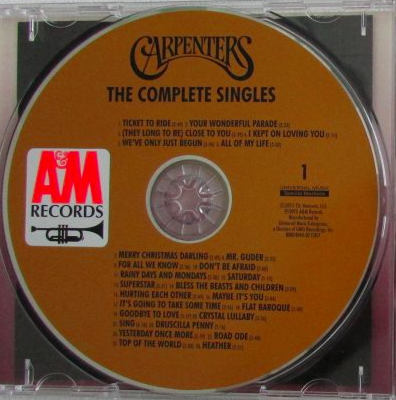
Carpenters: The Complete Singles (A&B sides)

Carpenters ruled the pop charts from 1970 – 1975, and much has been written about Carpenters “demise” in the latter part of the decade, as well as Richard’s addiction to drugs and Karen’s tragic battle with anorexia nervosa, but what isn’t ever cited it this fact: despite the personal and ultimately tragic difficulties the siblings endured after 1975, the duo never stopped having radio hits during Karen’s lifetime. In fact, Carpenters had a top 40 hit on every album released between 1970 and 1981. That’s quite a run.

Richard Carpenter displayed a penchant for fussing over the duo’s recordings as early as their first album, as the first single, a cover of The Beatles’, “Ticket To Ride,” was a remixed version from the album as well as the B-side, a remixed version of their anti-establishment anthem, “Your Wonderful Parade.” A few years later, Richard also remixed the title song they recorded for the soundtrack to Bless The Beasts And The Children for inclusion in the duo’s 1972 album, A Song For You. The following year, the duo remixed a number of songs for their hits collection, Singles, 1969-1973, including the #1 single, “Top Of The World.”


In fact, Carpenters singles, including B-sides, were often different mixes from the album versions, which made singles releases by the duo all the more an event, and over the decades, fans have often bemoaned the fact that the original single mixes were not the versions included on the myriad hits collections that surfaced during the 1980s and 1990s, as brother Richard continued to tinker with, remix, and re-record parts of songs, like a painter who keeps returning to classic paintings to add another coat of color. While fans appreciated the new variations on old favorites, they missed hearing the versions of the songs they remembered hearing on the radio.

49 years after the duo started making records, super fans now have, in one compilation, the entire US singles collection, in their original single mixes, via the PBS-only, triple CD release, Carpenters: The Complete Singles. The collection was made available in the fall and winter of 2015 as a pledge gift for public television viewers. The collection includes all the legendary hits (“Close To You,” “We’ve Only Just Begun,” “Rainy Days And Mondays,” “Superstar,” etc.), as well as the lesser-known classics (“It’s Going To Take Some Time,” “Won’t Last A Day Without You,” “Only Yesterday,” etc.) as well as some of the biggest head-scratchers the duo ever released as singles (“Goofus” and “Calling Occupants of Interplanetary Craft”). 

Listening to The Complete Singles was revelatory for me, in that it presents a more accurate depiction of the duo’s significant contribution to popular music than the run-of-the-mill hits collections did, as it offers mostly unknown B-sides as well, which often featured Carpenter’s unusual (and even peculiar, at times) compositions and showcased the duo’s artsier, edgier side. Seriously. This collection chronicles the duo’s avant-garde early albums, the trend-setting hit albums, the late-1970’s shotgun desperation albums (which always contained hidden gems), and the last few albums, which found the duo lost in post Captain & Tennille, adult-contemporary hell, barely treading water while recycling Air Supply demo rejects. 


It’s a fascinating aural journey, and the B-sides are even more revealing than the familiar singles. Some of the standout B-sides include:

Your Wonderful Parade: a Carpenter-penned, anti-establishment rant and great drumming work by Karen.
I Kept On Loving You: another rare lead vocal from brother Richard, one of his best, and another great Williams / Nichols tune.
All Of My Life: legend has it that the demo of this tune is what convinced Herb Albert to sign the duo in 1969.
Mr Guder: Another anti-establishment tune written about Carpenter’s ex-boss at Disneyland.
Saturday: I heard this recently in a regional department store commercial, and it’s still catchy as hell.
Bless The Beasts And The Children: the duo recorded this title track at the request of director, Stanley Kramer. It was included as the B-side to the Rock-and-Roll Hall Of Fame-inducted track, “Superstar” and charted as a single in its own right.
Maybe It’s You: this Carpenter-penned ballad could have been another single from the Close To You album.
Crystal Lullaby: beautiful, deep cut from Carpenters best album, A Song For You.
Road Ode: written by Carpenters band members after a concert in Carbondale, Illinois. This tune described the toll-taking rigors of life on the road and chronicled the duo’s disappointing personal lives as well as foreshadowed the ultimate tragedy that lie ahead.
Heather: a melencholy piano piece also used in an aspirin television commercial campaign around 1973.
This Masquerade: a long-time fan favorite and lost opportunity of a single.
Happy: another lost single opportunity, written by band member, Tony Peluso and long-time Carpenter collaborator, John Bettis.
If I Had You: from Karen’s unreleased (until 1996) solo album, here in a superior, remixed form.


And beyond the revelatory B-sides, here’s a list of tunes that appear in unique, single mixes:

Ticket To Ride: different intro, fun piano part (mono mix)
Your Wonderful Parade: shortened spoken intro, clean ending (mono mix)
I Kept On Loving You: clean opening and sweetened background vocals by Richard
Merry Christmas Darling: original, raw vocal
Mr. Guder: shortened version
Crystal Lullaby: clean ending (doesn’t blend into “Road Ode”)
Road Ode: clean opening (doesn’t enter with “Crystal Lullaby” ending)
I Won’t Last A Day Without You: different vocal and rockier arrangement
Please Mr. Postman: different vocal and arrangement
Santa Claus Is Coming To Town: different vocal and arrangement, completely different sax line
Calling Occupants Of Interplanetary Craft: shortened, no DJ intro
Can’t Smile Without You: different vocal and arrangement
Christmas Song: different vocal and arrangement
Don’t Cry For Me, Argentina: shortened, deleted opera intro
Those Good Old Dreams: original vinyl mix, which differed from the CD version
Make Believe It’s Your First Time: deleted spoken intro


This is an essential collection for not only completests, like I tend to be, but also for the casual fan who wants an accurate overview of the duo’s true pop music legacy. Skip the standard hits collections (that often misrepresent the duo and/or skip essential hits and album cuts), support your local PBS station, and shell out a little more scratch for this one-of-a-kind collection.

Saturday, December 28, 2013

“Now & Then,” by Carpenters


Now And Then was released in May of 1973 and is considered by many fans to be the duo's last album with the “classic” Carpenters sound. I’m inclined to agree. It featured two of their biggest hits, “Sing,” (#3, 1973) and the Carpenter-penned song about the early-1970’s “oldies” resurgence, “Yesterday Once More,” (#2, 1973), which became their biggest selling single, worldwide. While a bestseller at the time (and beyond the mysterious, trifold album artwork – is it a photograph? is it a painting? why aren’t they smiling – they were always smiling…? why is Karen’s face obscured? And their actual house loomed in the background, showing the upstairs bedroom window where Karen would collapse less than 10 years later, never to be resuscitated…), of their early albums, Now And Then tends to be their most overlooked and underappreciated these days, as it was, among other things, quirky, eclectic, eerie, joyful, eccentric, melancholy, silly, mysterious, and a TON of fun. In fact, I consider the album one of the most artsy in their canon (except, perhaps, their obscure and seldom-discussed debut, Offering, later repacked as, Ticket To Ride). The concept for Now And Then celebrated the “oldies,” as well as newer songs, having side one of the album consist of “contemporary” songs and side two focus on songs made popular about 10 years earlier.

The “contemporary” side was mostly that, I guess, except it featured a children’s song from television and a classic tune written over 20 years earlier, Hank Williams’ 1952 #1 Country smash, “Jambalaya (On The Bayou).” Hmm. I smell a concept fail. The duo wisely selected for side one Leon Russell’s, “This Masquerade,” which was an outstanding album track and remains a perennial fan favorite that probably should have been the lead-off single, or at least the follow-up to “Sing,” if, for nothing else, credibility purposes. And by the way, I love “Sing.” It’s simple. It’s sweet. “Sing. Sing a song. Make it simple to last your whole life long…” What’s not to love about that? But I’m guessing my fondness has more to do with my being 2 or 3 when it was ubiquitous on the radio that spring and it is a children’s song, after all, and Vh1 used it (affectionately, I think) on a promo a few years ago and it was from Sesame Street, and sigh…oh, what the hell? I just love it. The pretty piano instrumental, “Heather,” adds emotional depth to the proceedings on the first side, but (while absolutely beautiful) for the duo to record a song titled, “I Can’t Make Music,” at that point in their careers…it was just asking for potshots from rock journalists.

The “oldies” side consisted of a medley of the following early 1960’s tunes in this order: “Fun, Fun, Fun,” “The End Of The World,” “Da Do Run-Run,” “Dean Man’s Curve,” Johnny Angel,” “The Night Has A Thousand Eyes,” “Our Day Will Come,” and “One Fine Day.” Interspersed among the pop hits was Carpenters band member, Tony Peluso, playing the role of over-the-top radio DJ, complete with playful, shticky banter and even a “guess the golden oldies” radio contest. Peluso would reprise this role four years later as the DJ communicating with Martians (yes, you read that correctly) at the beginning of the duo’s 1977 top 40 hit, “Calling Occupants (Of Interplanetary Craft).” While certainly serving the concept of side two, in my view, the DJ banter pulls attention away from some remarkable vocals from sister Karen, most notably on “The End Of The World” and “Our Day Will Come,” which, in expanded versions, might have made exceptional singles.

In fact, the oldies/medley side contained some of Karen’s best vocal performances (an opinion the Reader’s Digest Collection vindicated some 25 years later, including the medley in remixed form and without the DJ shtick), with my only suggestion to the oldies side being that the siblings might have done well to include hits from back further, like “The Wayward Wind,” “It’s All In The Game,” “Que Sera, Sera,” “Chances Are,” and “You Send Me,” all which seem to have influenced the duo much more than “Da Do Run-Run” or “Dead Man’s Curve.” Who is with me on this?

Lambasted by critics upon its release, Now And Then was, perhaps understandably, but also unfairly judged as the artistic statement the duo wanted to make at that time. In reality, the album was hurriedly recorded amidst a breakneck schedule of touring and television appearances. Richard Carpenter wrote, “…as the limited time we had to record the album approached, it was clear to me that we had only enough material to complete one side of an LP, and even that was by completing a track we had recorded in 1972, ‘Jambalaya.’ Fortunately, we had an ace up our collective sleeve, resulting in a damn good album which became a worldwide bestseller: Karen and I introduced an oldies medley into our concert show starting in the summer of 1972, and it met with such an enthusiastic response, I decided to feature a version of it on side two of what would become Now And Then.

This album was followed by more breakneck touring for the duo in 1973 and 1974, which gave them precious little time to record the highly-anticipated follow-up, Horizon (1975). In the year that followed and to keep the duo on the radio, their record label mined two more gems from their classic, 1972 album, A Song For You, “Top Of The World” (#1, 1973) and “I Won’t Last A Day Without You,” (#11, 1974) as well as a Christmas-themed single, a jazzy reworking of “Santa Claus Is Coming To Town,” late in 1974, but the true follow-up single wasn’t released until December of 1974, the duo’s final #1, a cover of the Marvelettes’ “Please Mr. Postman,” and another retread of the oldies theme, a motif they would continue to pillage (“A Kind Of Hush,” #12/1976, and “Goofus,” #56/1976) through their final album with Karen, Made In America (“BE-echwood 4-5789, #74/1982).

The follow-up album, Horizon, was an intentional departure, demonstrating that the duo was interested in expanding beyond the trend-setting, early 1970s sound that brung ‘em to the dance. Horizon was musically complicated and thematically sophisticated. It was an album for grown-ups, whereas Now And Then seemed to have been recorded with the kiddos in mind. Maybe as a result, it seems to be the last album the siblings recorded where they seemed to be having any fun, which makes it a bittersweet listen today. In fact, while successive albums had moments of levity, the later albums found the duo trying too hard: to have hits, to be hip, to sound “different,” to be taken seriously. But on this album, in this moment in time, the siblings seemed to be in high spirits, and their art reflected this boundless joy - blissfully ignorant of the tragedy that lie ahead. And if for no other reason, Now And Then is noteworthy for that.

Sunday, July 7, 2013

"Baby I’m-A Want You," by Bread


In some ways, an album like Baby I’m-A Want You by a band like Bread, is the epitome of what this blog is all about: a long-forgotten, well-crafted, pop album by an underappreciated band that deserves a dusting off and another spin on the turntable (or another “click” on the iPod). And Bread was an exceptional band that just never received its due for being one of the most consistently listenable acts of the early 1970’s (although there was a terrific, non-ironic 2005 tribute album). Baby I’m-A Want You stands as one of their very best albums (that said, there’s something to appreciate about all of their original albums released in the precious, few years they were together between 1969 and 1977).

But first, a few U.S. career highlights from this significantly misunderstood band:
·           In their heyday, Bread racked-up 12 top-40 hit songs between 1970-1977
·           7 of those were top-10 hits
·           Their solitary #1 hit, “Make It With You,” is a classic slice of early-1970’s pop balladry and has been covered by many over the years, including the legendary Dusty Springfield, whose tragically obscure version stands as the definitive version and is well-worth seeking out

But besides these points on a graph, Bread was simply an exceptional band of songwriters and musicians, signaling in 1969, “…the birth of Californian soft rock, as David Gates and compatriots blended the folk-rock of The Byrds and Buffalo Springfield with a distinctly British melodicism and a streak of sentimentality borrowed from McCartney” (All Music, 2013). Lofty and accurate comparisons, no? In fact, beyond their work with Bread, individual band members had notable achievements through the 1970’s and 1980’s and into the 1990’s, including band members Rob Royer’s and James Griffin’s Oscar-winning song, “For All We Know,” from the film Lovers And Other Strangers in 1970, as well as David Gates’ #15 solo hit from the Neil Simon film, Goodbye Girl in 1977 and his #30 hit, “Took The Last Train,” in 1978. Additionally, Griffin, Royer, and Mike Botts had continued success in the 1980’s and 90’s as songwriters and performers in the Country Music genre. Clearly, band members were overflowing with talent and ideas.

And peaking at #3 in 1972, Baby I’m-A Want You, the band’s fourth album, was its biggest hit, featuring radio classics such as, “Mother Freedom,” #37 in July of 1971, “Baby I’m-A Want You,” #3 in October of 1971, “Everything I Own,” #5 in January of 1972, and “Diary,” #15 in April of 1972. And beyond the radio hits, Baby I’m-A Want You included fan favorites, like the rocking, “Down On My Knees,” the surreal, imaginative “Dream Lady,” which I’ve always suspected inspired Gary Wright’s 1976 hit, “Dream Weaver,” both musically and lyrically, the equally dreamlike, “Games Of Magic,” the wistful, “Just Like Yesterday,” and the finger-wagging, lecture song, “Daughter.” Along with “Mother Freedom,” the album’s other civically minded tune, “This Isn’t What The Governmeant,” (See what they’re doing there?) provides the typical left-of-center, partisan political commentary rock bands were issuing in those days. And Baby I’m-A Want You is an exceptional album for its time; a sun-faded Polaroid of a remarkable and melodic era in popular music.

But by 1973, internal tensions pulled the band apart, and depending on the account to which you most prescribe, the rift was either caused by ongoing tension between principle songwriters, David Gates and James Griffin, over which songs would be selected as singles, with Gates’ mellow songs having the best commercial track record over Griffin’s more rock-driven songs, or it was caused by the record label, Elektra, that wanted to keep the band pigeonholed as hit making, “softy” balladeers, when the band wanted to explore other sounds and highlight their edgier, guitar-driven work. Either way, the tension makes sense; if you look beyond their best known, Gates ballad singles, the band rocked as hard or harder than many of their contemporaries on the radio at that time (to wit, the trend-conscious, “Truckin’,” which captured the early-mid 1970’s romanticized fascination with the trucking profession, “Let Your Love Go,” and “London Bridge,” to name just a few). But whatever the actual formula for its demise, I guess longevity wasn’t meant to be for the band, and the good lads went their separate ways in 1978.

In the late 1990’s, Gates, Griffin, Botts and Knechtel came back together for the inevitable nostalgia reunion tour, but to the best of my knowledge, they recorded no new material at that time. Sad, that, as just a few years later, Mike Botts and James Griffin were dead from cancer. Larry Knechtel died of a heart attack in 2009. And that, music fans, was the end of Bread. Most folks who appreciate the hits have already sated their appetites with the double-CD, Bread Retrospective, released in the 1990’s, but there’s much buried treasure and even more insight to be gained from picking up the original albums that carried these 1970’s pop gems, which helped usher-in not only “soft rock,” but also the singer-songwriter era of the early 1970’s.

Sunday, June 16, 2013

“Carole King: Music,” by Carole King


In January of 1971, Carole King and a group of her friends recorded an album at A&M Records that defined an era. Tapestry was a classic-filled monster, holding the #1 position on Billboard’s album charts for four months that summer and launching King as a superstar. Up to that point, Carole King had been most known as a writer of pop hits (e.g., “Will You Love Me Tomorrow?” “(You Make Me Feel Like A) Natural Woman,” “Up On A Roof,” “The Loco-motion,” etc.), but Tapestry signaled the musician as one of the most reliable singles artists of the coming decade. Indeed, while her albums made less and less impact as the decade wore on (exceptions: Really Rosie, in 1975, and Pearls: Songs of Goffin and King, in 1980), King delivered some of the best, 1970’s radio-ready ear-candy, including such staples as, “Been To Canaan,” “Nightingale,” “Jazzman,” “Only Love Is Real,” and “Hard Rock Café,” helping us to navigate that tumultuous, stone washed decade.

Later that same year, King and friends returned to the studio, amidst the avalanche of promotion and performances that followed the massive success of Tapestry, and they crafted the magnificent and sadly underappreciated, Carole King: Music. Now, here’s the thing: rock writers always make one of three observations about any follow-up to a blockbuster album: 1.) “Ugh, it’s a mechanical, cash-in rewrite of their last album,” 2.) “Ugh, it’s an artist trying too hard to be fresh; they should have stuck with what they do best, you know, like on their last album,” 3.) “Sigh, the new album’s okay, but doesn’t quite possess the “magic” of their earlier work, you know, like on the last album.” Responding to Music, critics o’ the moment took all three positions: Robert Christgau called Music “mechanical,” and Rolling Stone suggested King had strayed too far from the Tapestry formula and that Music “…doesn't have its predecessor's sure, unified sense of style.” Sigh. “...Sometimes you win, sometimes you lose…”

I’d argue, however, that Music stands not only as one of King’s very best albums, ever, but constitutes an album of songs that any artist of that time (or of this time!) would have killed for.  In fact, two of the songs were recorded and made hits by other artists, including Karen and Richard Carpenter, who took “It’s Going To Take Some Time” to #12 in the spring of 1972. Ironically, that Music arrived in the wake of the Tapestry behemoth both ensured its success (it reached #1 just a few, short weeks after its December, 1971 release) and sealed its fate as the “oh, that was the so-so next album...” In fact, all of King’s subsequent (and consistently solid) work, post-Tapestry, faced the same, unfair comparison. No matter, though, as King has certainly received her due, with numerous Grammy awards, gold/platinum albums, hit songs, induction into the Rock-and-Roll Hall of Fame, and this May, King was the first woman recipient of the Library of Congress “Gershwin Prize” for popular song. Well done, Library of Congress, well done.

Music opens with the engrossing, “Brother, Brother,” written just months on the heels of Marvin Gaye’s classic single, “What’s Going On,” also with the phrase, “Brother, brother…” Was it an echo of Gaye’s lyric, as Rolling Stone suggested? A response to Gaye’s anthemic statement? Or was it more personal for King, whose own brother lived with disability? It works beautifully, either way, and remains a fan favorite, as well as one of many shoulda-been-a-hit-single songs off the album. Other songs that could have been big hits in 1972 include: “Surely,” which is an voluptuary slice of blue-eyed soul that could have been a big hit for King or for any number of R&B artists from the era (e.g., Al Green, Aretha Franklin, Dusty Springfield, Diana Ross, etc.), the sweet, James Taylor harmonied, “Song Of Long Ago,” and the vibrant, catchy-as-hell, “Brighter.”

All would have faired more than well amongst the trifle hit songs of 1972: “Alone Again (Natrually)” (Ugh. Because you deserve to be), “Candy Man” (Um, creepy much?), “Brand New Key” (Maybe, brand new...NO!), and “Baby, Baby Don’t Get Hooked On Me” (Don’t worry, I won’t. Seriously...). And speaking of singles, King’s label at the time, Ode, oddly released only one single from Music, the wonderfully sunny, “Sweet Seasons,” which reached #9 in the spring of 1972. Interesting side note: the B-side of the “Sweet Seasons” single is a lost gem, “Pocket Money,” from the long-forgotten 1972 film of the same name, starring Paul Newman and Lee Marvin: a great, unheard song, but widely available today on various CD and digital formats and one that I include as a “bonus” track for this superb album, as it was likely recorded during the Music sessions and nicely fits the overall tone of the album.

Other key album cuts include King’s version of her own song, “Some Kind Of Wonderful,” which is a slowed down iteration of The Drifters’ magnificent hit song from 1961. What I love about King’s version is how intimate the lyrics become with her tender reading. “Carry Your Load” contains a solicitous lyric about the support and kindness of an old friend. I think about this song most when I think about Kristina and Simon. And of course, there’s the title track, “Music,” that’s lyrics testify to the uplifting power of music, and more specifically, the sheer pleasure of writing music for the masses – what a great privilege that must be: “…Ah, summer is over; But the music keeps playing…pictures are forming inside my brain; Soon with the colors they'll rain together and grow…but the music keeps playing.” An apt description of the writing process.

And my favorite song is the album’s finale, “Back To California,” which Rolling Stone magazine, in 1971, called a “throwaway” track. It’s my favorite song on the album, albeit for personal reasons. In the last 24 months, it’s become Kristina’s and my theme song: a love song to our adopted home state. After flying back last year from a trip did we realize how thrilled we were to be coming “home” to California. King’s lyric resonated: “So won't you carry me back to California; I’ve been on the road too long; take me to the West Coast, daddy, and let me be where I belong…” I return to Carole King: Music, just as often.