In January of 1971, Carole King and a group of her friends
recorded an album at A&M Records that defined an era. Tapestry was a classic-filled monster, holding the #1 position on Billboard’s
album charts for four months that summer and launching King as a superstar. Up to that point, Carole King had been most known as a writer of pop hits (e.g., “Will You Love Me Tomorrow?” “(You Make Me Feel Like A) Natural Woman,” “Up On A Roof,” “The Loco-motion,” etc.), but Tapestry signaled the musician as one of the most reliable singles artists of the coming decade.
Indeed, while her albums made less and less impact as the decade wore on (exceptions: Really Rosie, in 1975, and Pearls: Songs of Goffin and King, in 1980), King
delivered some of the best, 1970’s radio-ready ear-candy, including such staples as,
“Been To Canaan,” “Nightingale,” “Jazzman,” “Only Love Is Real,” and “Hard Rock Café,” helping us to navigate that tumultuous, stone washed decade.
Later that same year, King and friends returned to the studio, amidst the avalanche of promotion and performances that followed the massive success of Tapestry, and they crafted the magnificent
and sadly underappreciated, Carole King: Music. Now, here’s the thing: rock writers always make one of three observations
about any follow-up to a blockbuster album: 1.) “Ugh, it’s a mechanical,
cash-in rewrite of their last album,” 2.)
“Ugh, it’s an artist trying too hard to be fresh; they should have stuck with
what they do best, you know, like on their last album,” 3.) “Sigh, the new album’s okay, but doesn’t quite possess the
“magic” of their earlier work, you know, like on the last album.” Responding to Music,
critics o’ the moment took all three positions: Robert Christgau called Music “mechanical,” and Rolling Stone suggested King had strayed
too far from the Tapestry formula and
that Music “…doesn't have its
predecessor's sure, unified sense of style.” Sigh. “...Sometimes you win, sometimes
you lose…”
I’d argue, however, that Music
stands not only as one of King’s very best albums, ever, but constitutes an album of
songs that any artist of that time (or of this time!) would have killed
for. In fact, two of the songs were
recorded and made hits by other artists, including Karen and Richard Carpenter, who took
“It’s Going To Take Some Time” to #12 in the spring of 1972. Ironically, that Music arrived in the wake of the Tapestry behemoth both ensured its
success (it reached #1 just a few, short weeks after its December, 1971 release)
and sealed its fate as the “oh, that was the so-so next album...” In fact, all of
King’s subsequent (and consistently solid) work, post-Tapestry, faced the same, unfair comparison. No matter, though, as
King has certainly received her due, with numerous Grammy awards, gold/platinum
albums, hit songs, induction into the Rock-and-Roll Hall of Fame, and this May,
King was the first woman recipient of the Library of Congress “Gershwin Prize”
for popular song. Well done, Library of Congress, well done.
Music opens with
the engrossing, “Brother, Brother,” written just months on the heels of Marvin
Gaye’s classic single, “What’s Going On,” also with the phrase, “Brother,
brother…” Was it an echo of Gaye’s lyric, as Rolling Stone suggested? A
response to Gaye’s anthemic statement? Or was it more personal for King, whose
own brother lived with disability? It works beautifully, either way,
and remains a fan favorite, as well as one of many shoulda-been-a-hit-single songs off the album. Other songs that
could have been big hits in 1972 include: “Surely,” which is an voluptuary
slice of blue-eyed soul that could have been a big hit for King or for any
number of R&B artists from the era (e.g., Al Green, Aretha Franklin, Dusty Springfield, Diana Ross, etc.), the sweet, James Taylor harmonied, “Song Of Long Ago,” and the
vibrant, catchy-as-hell, “Brighter.”
All would have faired more than well amongst the trifle hit
songs of 1972: “Alone Again (Natrually)” (Ugh. Because you deserve to be), “Candy Man” (Um, creepy much?), “Brand New Key” (Maybe, brand new...NO!), and “Baby, Baby Don’t Get Hooked On Me” (Don’t worry, I won’t. Seriously...). And
speaking of singles, King’s label at the time, Ode, oddly released only one single
from Music, the wonderfully sunny,
“Sweet Seasons,” which reached #9 in the spring of 1972. Interesting side note:
the B-side of the “Sweet Seasons” single is a lost gem, “Pocket Money,” from
the long-forgotten 1972 film of the same name, starring Paul Newman and Lee
Marvin: a great, unheard song, but widely available today on various CD and digital
formats and one that I include as a “bonus” track for this superb album, as it was likely recorded during the Music sessions and nicely fits the overall tone of the album.
Other key album cuts include King’s version of her own song,
“Some Kind Of Wonderful,” which is a slowed down iteration of The Drifters’ magnificent
hit song from 1961. What I love about King’s version is how intimate the lyrics
become with her tender reading. “Carry Your Load” contains a solicitous lyric about
the support and kindness of an old friend. I think about this song most when I
think about Kristina and Simon. And of course, there’s the title track,
“Music,” that’s lyrics testify to the uplifting power of music, and more
specifically, the sheer pleasure of writing music for the masses – what a great
privilege that must be: “…Ah, summer is over; But the music keeps playing…pictures
are forming inside my brain; Soon with the colors they'll rain together and
grow…but the music keeps playing.” An apt description of the writing process.
And my favorite song is the album’s finale, “Back To California,” which Rolling Stone
magazine, in 1971, called a “throwaway” track. It’s my favorite song on the
album, albeit for personal reasons. In the last 24 months, it’s become
Kristina’s and my theme song: a love song to our adopted home state. After flying back last year from a trip did we realize how thrilled we were to be coming
“home” to California. King’s lyric resonated: “So won't you carry me back to California; I’ve been on the road too long; take me to the
West Coast, daddy, and let me be where I belong…” I return to Carole King: Music, just as often.
I bought this album in early September of 2002, shortly
after its release and just one year after large-scale terrorism single-handedly
imploded the United States with not only the magnitude of its evil destruction,
but also by the debacle and needless disfigurement that would become a series of decade-long wars
in the Middle East. And like everybody else in the country seemed to be in
those days, I was in heavy introspection and reinvention mode. Thank God for
James Taylor. I was ready for a diversion and for something hopeful, and after spending
my 20’s in the wonderful town where I went to college I decided to take a job
in a different location. And while a new work opportunity made me hopeful for
what might lie ahead, the unfamiliar territory made me reflective and sentimental.
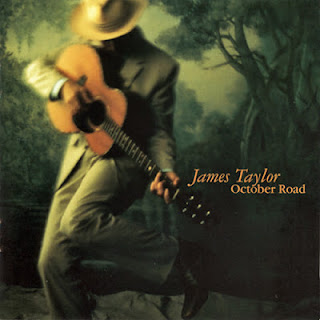
This tender album served as my travel companion as I said “goodbye” to DeKalb,
Illinois and made my new home in Lake Forest, Illinois.
Lyrically wistful and nostalgic, on October Road, Taylor sings about high school crushes, first kisses,
football games, and the sights, sounds and smells of the months between the autumnal
equinox to the winter solstice. In fact, songs on the album reference the
entire second half of the calendar year: July through December. “On The 4th Of July,” “September Grass,” “October Road,” “Caroline I See You,” and even the
seemingly out-of-place, but somehow-still-works cover of the holiday classic,
“Have Yourself A Merry Little Christmas.” The album suggests the second half of
the year as a time to wonder and rejoice, versus the hectic, hustle-and-bustle
of the first two seasons. October Road
reminds me of one of the best periods of my own life: the first year of being
married to my partner. The album was the soundtrack to so many Chicago-land
road trips together as Kristina and I navigated a new geographic region,
weekend errands and groceries, carefree apartment living, and generally getting
better acquainted. I treasure those days.
While there are numerous stand-out tracks on this album
(i.e., the aforementioned, “September Grass” and the uber-mellow, grilled
cheese and hot chocolate, one-two punch of “Caroline I See You” and “Baby Buffalo”), the songs on October Road
are also of a piece, conjuring autumn and winter imagery: colored leaves on the
ground, family and good friends, crisp, November air, and the smell of bonfires,
hayrides, and pumpkin pie. Taylor’s lyrics on this album are road-worn and
familiar, cozy and comforting. In fact, October
Road reads like the third and fourth season travelogue of a man who has
finally achieved a certain level of satisfaction and contentment with his life.
And if my James Taylor history is correct, this serenity has been hard-won.
Most folks over a certain age know about James Taylor’s “soft
rocking, hard living” early days, as one of the principle auteurs of the
singer/songwriter genre (along with Joni Mitchell, Neil Young, Carly Simon, Bob Dylan, etc.), he created classic 1970’s hits, like “Fire and Rain,” “Handy Man,” “Your Smiling Face,” “Shower The People,” and his only number one, the
1971 Carole King-penned, “You’ve Got A Friend.” James Taylor has endured mental
illness, rock stardom, drug abuse, and the fleeting trends of pop music, which
tend to favor the tastes of 13-18 year-olds. Following suit, Taylor started to
lose traction on the pop singles charts in the early 1980’s, as MTV, with it’s neon
lights, hairspray, and synthesizers, effectively killed the radio star. The
80’s and 90’s passed quietly for Taylor, who released a sublime album every
five years or so to his faithful followers, toured to support his new songs,
and otherwise grew comfortable in his role as elder statesman of rock music.
And we fans keep coming back for more, most recently on the sold out “Troubadours”
tour with the equally legendary, Carole King. David Crosby has said that the
debut album of a singer-songwriter represents 10 years of the musician’s work,
but the second album, often written between gigs while promoting the first release,
that’s where you can tell if an
artist is any good. October Road is Taylor’s 15th album. Still good.
Very good, indeed.

Some of the greatest albums in the Rock-and-Roll canon were recorded in the early 1970s. To wit, “What’s Going On?” by Marvin Gaye, “Tapestry,” by Carole King, “Bridge Over Troubled Water,” by Simon and Garfunkel, “Dark Side Of The Moon,” by Pink Floyd, and classic recordings by David Bowie, Elton John, Paul McCartney, John Lennon, Nick Drake, and James Taylor, to name just a few. One of my favorites from the era, and a remarkably influential Polaroid from that period of popular music, was the second album by the brother-sister duo from Downey, California: Carpenters, Close To You. “Rollingstone” magazine lists the album as one of the “Best 500 albums” of all time - in the top 200 no less! It's also listed in the 2005 book, "1001 Albums You Must Hear Before You Die," which inspired the moniker for this blog. And while not the artistic pinnacle of the duo’s career (that would be two albums later, the 1972 classic, A Song For You), it was one of Carpenters best sellers and the album that launched their highly successful, but ultimately tragic career.
The Carpenter family moved from New Haven, Connecticut to Downey, California in the early 1960’s for a job opportunity for Dad Carpenter and to be closer to Los Angeles, where Richard could be closer to the nexus of the music industry. At that time, Richard was the sole musician in the family, while Karen mostly tagged along behind her big brother, tapping the drum kit grudgingly purchased for her by her parents ("girls don’t play the drums"). It wasn’t until later, when recording demos in a friend’s garage studio that, on a whim, Richard put Karen on the microphone, and he realized his little sister could sing. Karen reportedly wasn’t convinced of her remarkable gift until sometime later, with some close friends suggesting she always thought of herself as a “drummer who sang.”
After a few years of gigging around the L.A. music scene, sending demos to and getting rejections from every major recording studio in the industry, the siblings landed a short-lived recording contract with RCA (the prize for winning the Hollywood Bowl “Battle of the Bands,” contest in 1966). The songs recorded with RCA never saw the light of day, however, and the band was released from their contract, as RCA execs felt the duo were not commercial enough. A few years later, their demo landed in the cassette player of Herb Albert, popular musician and co-founder of A&M Records, and he signed the duo in 1969. Their first album, Offering, was less-than-meteoric (although well-worth seeking out), but yielded their first chart single, a startling re-imagination of The Beatles’ classic, “Ticket to Ride.”

After the single and album finished a brief run on the charts, A&M decided to give the duo one more chance, but this time by releasing a final, make-or-break single. Essentially at their label’s mercy, Richard and Karen agreed to record a saccharine Burt Bacharach song, which had been released numerous times in the previous decade to little success. But Herb Albert felt it would be right for Karen’s voice, and frankly, while not thrilled to do so, the siblings had no choice and recorded that tune with over-the-top lyrics (“On the day that you were born the angels got together and decided to create a dream-come-true, so they sprinkled moon dust in your hair and golden starlight in your eyes of blue.”). After the recording session for “(They Long To Be) Close To You,” Herb Albert and Richard Carpenter sat on the stoop in the A&M parking lot, discussing the potential for the single. Carpenter predicted, “It will either be a #1 hit or the biggest stiff the label has ever recorded.” “Close To You” became Carpenters’ first #1 single, remaining in the top position for a month and catapulting the siblings into instant fame and a whirlwind of recording and promotional activity.
And this is how the Close To You album was born, amidst a flurry of activity in the wake of the “overnight success” of the Bacharach single. A&M wanted to leverage the success of the monster hit song, while Richard and Karen were just grateful to still have a recording contract. But having gone through most of their original material on their first album, Richard was left with the task of finding new songs for the follow-up album. Serendipity intervened. As “Close To You” rose on the charts, Richard saw a bank commercial on late night television. He couldn’t help but notice the background song, written by Paul Williams and Roger Nichols, about a young couple just getting started, and he wondered if the jingle existed as a complete song. It didn’t, but when Williams and Nichols were contacted about a full-song, they happily obliged, finishing “We’ve Only Just Begun” by adding another verse and submitting it for recording.
The rest of the Close To You album was recorded in like manner: hurriedly, between promotional engagements and concerts, but the results were astonishing, for an album thrown-together in the duos precious free time between gigs. Including a mix of Carpenter-penned originals with Bacharach and Roger Nichols and Paul Williams songs and another Lennon-McCartney cover, the album was probably the last “rock” effort the duo produced, as they spent the remainder of the early seventies focusing on their sublime hit pop singles. Speaking of hit singles, I’ve always held that, while containing two of the duo’s best-known songs, the album could have spawned even more hits, including the Carpenter original, “Maybe It’s You,” and the Bacharach cover of the Shirelles’ 1961 top-ten hit, “Baby It’s You.” The siblings’ demonstrate their lesser-appreciated rock-and-roll leanings with the Beatles’ “Help!” and the grandiose album closer, the spellbinding Carpenter original, “Another Song.”
The album was a monster, selling millions of copies and launching the duo into the chaos that would be the next five years of hits, constant touring, and television appearances. In hindsight, it was too much. I’ve often wondered what might have been, had the duo taken the remainder of the 1970s off after their hits compilation around the middle of the decade. But sadly, they got caught up in the star-maker machinery, unwisely chasing horrid 1970’s pop culture trends, and essentially losing focus. And while the hits never stopped (in fact, the duo enjoyed top 40 hits on every album released during Karen’s lifetime, up to their final hit single, “Touch Me When We’re Dancing,” #16 in 1981), their albums in the latter part of the decade, while always delivering one or two gems (mostly due to Karen’s creamy, alabaster voice), were largely forgettable efforts. But Close To You reflects a moment when the siblings were young and optimistic. They'd only just begun to do their thing, and the album accidentally became an early 1970’s classic.