Showing posts with label Bob Dylan. Show all posts

Saturday, October 13, 2012

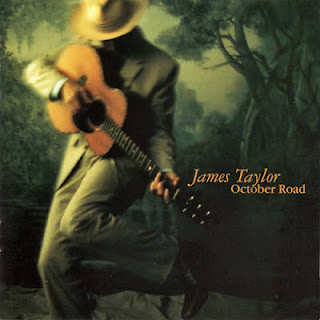
"October Road," by James Taylor


I bought this album in early September of 2002, shortly after its release and just one year after large-scale terrorism single-handedly imploded the United States with not only the magnitude of its evil destruction, but also by the debacle and needless disfigurement that would become a series of decade-long wars in the Middle East. And like everybody else in the country seemed to be in those days, I was in heavy introspection and reinvention mode. Thank God for James Taylor. I was ready for a diversion and for something hopeful, and after spending my 20’s in the wonderful town where I went to college I decided to take a job in a different location. And while a new work opportunity made me hopeful for what might lie ahead, the unfamiliar territory made me reflective and sentimental. This tender album served as my travel companion as I said “goodbye” to DeKalb, Illinois and made my new home in Lake Forest, Illinois.

Lyrically wistful and nostalgic, on October Road, Taylor sings about high school crushes, first kisses, football games, and the sights, sounds and smells of the months between the autumnal equinox to the winter solstice. In fact, songs on the album reference the entire second half of the calendar year: July through December. “On The 4th Of July,” “September Grass,” “October Road,” “Caroline I See You,” and even the seemingly out-of-place, but somehow-still-works cover of the holiday classic, “Have Yourself A Merry Little Christmas.” The album suggests the second half of the year as a time to wonder and rejoice, versus the hectic, hustle-and-bustle of the first two seasons. October Road reminds me of one of the best periods of my own life: the first year of being married to my partner. The album was the soundtrack to so many Chicago-land road trips together as Kristina and I navigated a new geographic region, weekend errands and groceries, carefree apartment living, and generally getting better acquainted. I treasure those days.

While there are numerous stand-out tracks on this album (i.e., the aforementioned, “September Grass” and the uber-mellow, grilled cheese and hot chocolate, one-two punch of “Caroline I See You” and “Baby Buffalo”), the songs on October Road are also of a piece, conjuring autumn and winter imagery: colored leaves on the ground, family and good friends, crisp, November air, and the smell of bonfires, hayrides, and pumpkin pie. Taylor’s lyrics on this album are road-worn and familiar, cozy and comforting. In fact, October Road reads like the third and fourth season travelogue of a man who has finally achieved a certain level of satisfaction and contentment with his life. And if my James Taylor history is correct, this serenity has been hard-won.

Most folks over a certain age know about James Taylor’s “soft rocking, hard living” early days, as one of the principle auteurs of the singer/songwriter genre (along with Joni Mitchell, Neil Young, Carly Simon, Bob Dylan, etc.), he created classic 1970’s hits, like “Fire and Rain,” “Handy Man,” “Your Smiling Face,” “Shower The People,” and his only number one, the 1971 Carole King-penned, “You’ve Got A Friend.” James Taylor has endured mental illness, rock stardom, drug abuse, and the fleeting trends of pop music, which tend to favor the tastes of 13-18 year-olds. Following suit, Taylor started to lose traction on the pop singles charts in the early 1980’s, as MTV, with it’s neon lights, hairspray, and synthesizers, effectively killed the radio star. The 80’s and 90’s passed quietly for Taylor, who released a sublime album every five years or so to his faithful followers, toured to support his new songs, and otherwise grew comfortable in his role as elder statesman of rock music. And we fans keep coming back for more, most recently on the sold out “Troubadours” tour with the equally legendary, Carole King. David Crosby has said that the debut album of a singer-songwriter represents 10 years of the musician’s work, but the second album, often written between gigs while promoting the first release, that’s where you can tell if an artist is any good. October Road is Taylor’s 15th album. Still good. Very good, indeed. 

Friday, October 1, 2010

"2:00 A.M. Paradise Cafe'," by Barry Manilow


I like Barry Manilow. Well, I like his music, anyway; I’ve never met the legendary entertainer, who stepped onto the pop music landscape in 1973, wearing platform boots and a sequined, blue jumpsuit and hasn’t been out of the spotlight since. Now, mind you, I’m not a “Manilooney,” one of the superfans who follow Manilow around the country, show to show, like the “Deadheads” to The Grateful Dead, but I would consider myself at least a rank-and-file fan of “the old songs.” Don’t laugh. You know you stop on “Copacabana” when you’re by yourself in the car. Admit it. And, besides, there’s no shame in appreciating songs adored by ba-jillions. I mean, legions of “Fanilows” can’t be wrong, right?

Still a skeptic? Humph! Then don’t take my word for it, let the evidence speak for itself: from 1974 to 1983, Manilow placed 25 songs into Billboard’s Top 40 charts, with three number ones and millions of albums sold in a career that’s lasted almost 40 years. I'll grant that album sales, alone, do not, necessarily, place an artist on a "Must Hear" list, but consider that in the early 70’s, Frank Sinatra reportedly said of Manilow, “He’s next.” Not a bad endorsement. Even Axl Rose, 1980's icon and metal head, purports to have been inspired by Manilow’s first hit, “Mandy.” True story. Look it up. And today, Manilow is undeniably woven into the fabric of popular culture, being lampooned and heralded simultaneously over the years in television shows, like “Night Court,” in the 1980’s and more recently, “Ally McBeal,” “The Simpsons,” and even having his own “theme night” on “American Idol.” Not convinced yet? Sigh…whatever. Bob Dylan agrees with me (Again, true story. Look it up).

But while his best-known songs and albums from the 1970’s get most of the attention, in 1984, Manilow quietly recorded what many consider to be his very best album: the smoky, jazzy, barroom-in-the-middle-of-the-night, sleeper, 2:00 A.M. Paradise Café. The album was a change of pace for the adult contemporary superstar, who had spent the previous decade ubiquitous on the radio, but by the early 1980’s, Manilow had sputtered into a rough patch, artistically. While each, new release was hitting the coveted, million sales mark, he was in a holding pattern, creatively, and suddenly, he found his polished pop records playing awkward kid brother in a “Top 40” playground filled with future classics, like The Clash’s “Rock The Casbah,” John “Cougar” Mellencamp’s, “Jack and Diane,” The Human League's, “Don’t You Want Me?” and Joan Jett & The Blackhearts’ “I Love Rock & Roll.” Not likely to compete in the new-wave and rock-dominated radio landscape, Manilow seemed to purposely remove himself from the contest, and the resulting album was one of the most memorable of his career.

The concept of Paradise Café started by accident, when Ginger Mercer, the wife of the legendary songwriter, Johnny Mercer, sent Manilow a cache of Mercer’s lyrics, inviting him to compose music to any of the verses that piqued his interest. Manilow obliged, writing the music for the astounding, nostalgia-tinged poem, “When October Goes.” Stemming from that piano masterpiece, Manilow conceived the idea of an entire album of original, jazz-styled songs hovering around the motif of a nightclub at 2 o’clock in the morning, whose customers should have called it a night, but who, for that moment, the skuzzy little bar seems to offer more than whatever is, or whatever isn’t waiting at home.

What I also love about this album is the “samey” feeling the melodies have, each riffing off the title track, but also holding their own as individual songs. Manilow recruited legendary jazz musicians to assist on the record, including Gerry Mulligan, Bill Mays, Mundell Lowe, Mel Torme’, and Sarah Vaughan, the latter two sharing vocals on two songs, “Big City Blues,” and “Blue,” respectively. The duets are standouts on the album, and Manilow’s exchanging lines with Torme’ and Vaughan reveals, not a vocal peer, but a fan, enraptured by this once-in-a-lifetime chance to share his songs with the very artists, who inspired him to become a musician in the first place.

I posit that Manilow’s contribution to the pop pantheon ended after Paradise Café, and while many thought the album, departure that it was, to be only a brief detour, for the next 35 years and up to present day, he’s never really returned to his pop roots, rarely even recording any of his own compositions. In fact, after Paradise, the musician’s modus operandi was to turn-in album after album of gimmicky, concept records, from swing music to show tunes to big band music, to three Christmas albums, to the horrifyingly contrived series that followed: the “Best Songs Of The 50’s,” “Best Songs Of The 60’s,” “Best Songs Of The 70’s,” “Best Songs Of The 80’s,” Sigh…was their a 90’s iteration? Who knows? Who cares? The albums were an awful dénouement in the oeuvre of a gifted entertainer. but Manilow is in the studio as I write this, working on his next album, which is rumored to harken back to his glory days of the 1970’s. If you’re reading this, Barry, we're all tryin’ to get the feelin’ again. Don’t let us down.

Post Script: I argue that the gist of Paradise Cafe', like much of Manilow's career, is more about the love of music than forging "new ground" or pandering to the "hip" rock scene, and over the years, Manilow often showed this hand by singing songs about songs (to wit: “I Write The Songs,” “This One’s For You,” “Beautiful Music,” “The Old Songs,” and I Made It Through The Rain, a #10 hit in 1980, that’s original lyrics lovingly describe the craft of song writing), maybe it was inevitable that Manilow relegate himself to an oldies act, or maybe the music and passion just went out of fashion for him. I guess we have to wait and see…