Saturday, October 13, 2012

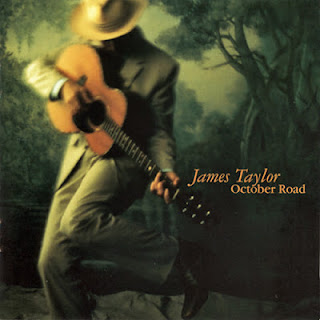
"October Road," by James Taylor


I bought this album in early September of 2002, shortly after its release and just one year after large-scale terrorism single-handedly imploded the United States with not only the magnitude of its evil destruction, but also by the debacle and needless disfigurement that would become a series of decade-long wars in the Middle East. And like everybody else in the country seemed to be in those days, I was in heavy introspection and reinvention mode. Thank God for James Taylor. I was ready for a diversion and for something hopeful, and after spending my 20’s in the wonderful town where I went to college I decided to take a job in a different location. And while a new work opportunity made me hopeful for what might lie ahead, the unfamiliar territory made me reflective and sentimental. This tender album served as my travel companion as I said “goodbye” to DeKalb, Illinois and made my new home in Lake Forest, Illinois.

Lyrically wistful and nostalgic, on October Road, Taylor sings about high school crushes, first kisses, football games, and the sights, sounds and smells of the months between the autumnal equinox to the winter solstice. In fact, songs on the album reference the entire second half of the calendar year: July through December. “On The 4th Of July,” “September Grass,” “October Road,” “Caroline I See You,” and even the seemingly out-of-place, but somehow-still-works cover of the holiday classic, “Have Yourself A Merry Little Christmas.” The album suggests the second half of the year as a time to wonder and rejoice, versus the hectic, hustle-and-bustle of the first two seasons. October Road reminds me of one of the best periods of my own life: the first year of being married to my partner. The album was the soundtrack to so many Chicago-land road trips together as Kristina and I navigated a new geographic region, weekend errands and groceries, carefree apartment living, and generally getting better acquainted. I treasure those days.

While there are numerous stand-out tracks on this album (i.e., the aforementioned, “September Grass” and the uber-mellow, grilled cheese and hot chocolate, one-two punch of “Caroline I See You” and “Baby Buffalo”), the songs on October Road are also of a piece, conjuring autumn and winter imagery: colored leaves on the ground, family and good friends, crisp, November air, and the smell of bonfires, hayrides, and pumpkin pie. Taylor’s lyrics on this album are road-worn and familiar, cozy and comforting. In fact, October Road reads like the third and fourth season travelogue of a man who has finally achieved a certain level of satisfaction and contentment with his life. And if my James Taylor history is correct, this serenity has been hard-won.

Most folks over a certain age know about James Taylor’s “soft rocking, hard living” early days, as one of the principle auteurs of the singer/songwriter genre (along with Joni Mitchell, Neil Young, Carly Simon, Bob Dylan, etc.), he created classic 1970’s hits, like “Fire and Rain,” “Handy Man,” “Your Smiling Face,” “Shower The People,” and his only number one, the 1971 Carole King-penned, “You’ve Got A Friend.” James Taylor has endured mental illness, rock stardom, drug abuse, and the fleeting trends of pop music, which tend to favor the tastes of 13-18 year-olds. Following suit, Taylor started to lose traction on the pop singles charts in the early 1980’s, as MTV, with it’s neon lights, hairspray, and synthesizers, effectively killed the radio star. The 80’s and 90’s passed quietly for Taylor, who released a sublime album every five years or so to his faithful followers, toured to support his new songs, and otherwise grew comfortable in his role as elder statesman of rock music. And we fans keep coming back for more, most recently on the sold out “Troubadours” tour with the equally legendary, Carole King. David Crosby has said that the debut album of a singer-songwriter represents 10 years of the musician’s work, but the second album, often written between gigs while promoting the first release, that’s where you can tell if an artist is any good. October Road is Taylor’s 15th album. Still good. Very good, indeed. 

Sunday, September 23, 2012

"Our Time In Eden," by the 10,000 Maniacs


My friend, Rachel, recently suggested I write about the 10,000 Maniacs breakthrough 1987 album, In My Tribe, which was, essentially, their introduction to a mass audience and my first listen to this remarkable band. But as I was listening to my Maniacs catalogue, I realized that I strongly preferred their final album with Natalie Merchant, Our Time In Eden, released in the fall of 1992, when I was starting my senior year of college. It brings back great memories: I didn’t have many financial resources in those days, so I don’t remember exactly how I purchased a copy of the album that September, but I did, and as it turns out, it was a worthwhile investment, as it turned out to be the best album they ever recorded.

The Maniacs followed-up In My Tribe, with the daunting, preachy, Blind Man’s Zoo, which had one solitary, mostly-cheerful song (and best cut on the album), “Trouble Me,” in which the tender video depicts Merchant as the key social director to a certain, lucky senior citizen. The rest of the LP was depressing and funereal. I remember buying the cassette of Blind Man’s Zoo the week I graduated high school in May of 1989. I would listen to it in my Walkman while I mowed the lawn at the farm that summer, and the maudlin music somehow comforted me as I dreaded the terrifying prospect that lie ahead: leaving my beautiful, Neponset countryside for university dorm life. Fitting, then, that the band decided to bookend my college career by releasing their follow-up to Blind Man’s Zoo the fall of my final year at Northern Illinois University.

Our Time In Eden, receiving a perfect, 5-star rating in Rolling Stone magazine at the time (a rating, which, somehow lost two stars over the past two decades in preceding RS publications), was exactly what I suspected from the band: serious-minded, catchy, and socially-conscious jingle-jangle-pop that was no-doubt informed by The Byrds, Big Star, and early-REM (relevant sidebar: I'm so glad REM retired; there's something to be said about bowing-out before it's too late: I'm lookin' at you, U2...). What’s not to love about that hybrid? Finally ejecting the tyrannical (and reportedly verbally abusive to the Maniacs) Peter Asher as producer, the band was able to loosen-up and have fun. Merchant’s lyrics are always aimed squarely at the heart and at the head, but on Eden, Merchant and the Maniacs kicked-up the fun, adding Motown horns and hard rock (no joke!) guitars to the folk-pop mix to which we fans had grown accustomed. The result? Sublime and timeless ear-candy.

The first “hit” on the album (#66) was the optimistic and hella-catchy, “These Are Days,” with a video featuring Merchant in a cute, white Gap sweater (only $12.99!) singing on top of New York skyscraper, with break-away shots of children running through the woods (was one of those kids wearing a Nixon mask? I’m not sure, but what about the boy with the “kiss me quiet” written on his forehead and the girl with the “squeeze me slow!” written on her stomach?) and college students playing footsy (I didn’t understand the point of the eye-patch on the dude, either, but I just went with it). Weird, you say? Not in the early 90’s, when flannel-wearing denizens of the era would have referred to it as simply, “granola.” I hate flannel shirts and black jeans to this day.

The second modest hit on the album (#67) was the Motown-influenced “Candy Everybody Wants,” about the evils of commercialism (“engineered opinions”) with the newly fashion-conscious Merchant blending genders in both a suit AND an evening gown, interspersed with the interchangeable “Simply Irresistible” girls and faux advertisements (“…lust and hate is the candy, and blood and love tastes so sweet”). Sigh... Socially conscious pop at it’s best. The irony of multi-million selling pop artists leveraging MTV to comment about the “travesty” of commercialism, to wit: “I don't want no lies, I don't watch TV, I don't waste my time reading magazines…” 

Nevertheless, Our Time In Eden is truly magnificent pop music, and if you’ve never heard it, I can’t recommend it enough. And thanks, Rachel, for reminding me of the 10,000 Maniacs. Great band. Great album. 

Monday, September 3, 2012

You Don't Mess Around With Jim, by Jim Croce


While only a fleeting 5-year recording career, Jim Croce charted an impressive ten songs in Billboard’s “Hot 100,” with eight of those hits reaching the top 40 and five reaching the top 10, two of which reached the #1 spot, “Bad, Bad Leroy Brown,” and “Time In A Bottle,” both in 1973. Croce’s third album, You Don’t Mess Around With Jim, spent 5 weeks at #1 in 1974 and is his best. The album was also his commercial breakthrough, spawning three top-20 singles, “You Don’t Mess Around With Jim (#8, 1972),” “Operator (That’s Not The Way It Feels) (#17, 1972),” and the aforementioned, “Time In A Bottle (#1, 1973),” which gained momentum after being featured in a long-forgotten TV movie, “She Lives!” 

But the hit singles were only a small part of this album’s impact.The non-singles on the album contain hidden gems, which reflect some of Croce’s favorite themes, including the playful country romp, “Hard Time Losin’ Man,” with its twangy, back porch shuffle and saucy background vocals, and the contemplative, “Walkin’ Back To Georgia,” where the disillusioned narrator returns humbly to his hometown sweetheart after failing his dreams (in fact, Croce seemed particularly drawn to that specific sentiment, revisiting the topic for several songs on this album alone: the Georgia tune as well as “New York’s Not My Home” and “Box #10”). 


The best non-single on the album and the song that finds its way onto most Croce compilations is “A Long Time Ago,” which is characteristically Croce: mellow, maudlin, and catchy as hell. A close second is "Photographs And Memories," which is, again, maudlin and catchy, has also become a perennial Christmas holiday classic. The optimistic album closer, “Hey Tomorrow,” turned out to be both prophetic and, tragically, short-lived for the author.


That Jim Croce is a musician who’s not received his due can likely be relegated to two mitigating factors: 1.) his untimely death at the age of 30, and 2.) his widow, Ingrid’s, ongoing battle with his recording and publishing companies that, seeing his hit-making potential early-on, signed the young and naïve musician to a horrifyingly unfair contract. Eventually, Ingrid was victorious, winning back royalties for her husband’s catalogue and spending the next 40 years promoting his legacy through various reissues and compilations. Over the years, Croce has often been described as “the voice of the American workingman,” and I guess that means because his songs describe “everyday people” in “everyday situations,” but I’ve always struggled with that moniker. I think Croce’s go-to themes: love, loss, striving, losing, and hopeful persistence, are universal and transcend any one sub-group. Who hasn’t felt those things?


I believe it was my brother, Jay, who introduced my siblings and me to Jim Croce, and when I was very young, I sometimes confused my brother and Croce as the same person (I know, crazy, isn’t it? I also used to believe as a small child that Paul Williams was merely the shorter iteration of John Denver – sigh…too many episodes of “Big John, Little John,” I guess). I’ve often wondered what Croce’s career and life might have been like had he survived the plane crash. How might he have evolved, artistically? Would he have ventured into disco (don’t laugh, Seals and Crofts did it!) or songs about outer space as so many did in the latter part of the 70’s (I’m lookin’ at you, Elton John, David Bowie, and Karen & Richard Carpenter!)? Would he have included synthesizers and drum machines in his 1980’s albums (vis-à-vis Carole King, Joni Mitchell)? How might his “Vh1: Behind The Music” episode have played out in the 1990’s had Croce lived? Would there have been a stint in rehab? How many “experimental periods” might we have had to endure? Sigh… Sadly, we’ll never know, and honestly, I suspect I would have hung in there with him through all of it. 


Sunday, June 10, 2012

"Born And Raised," by John Mayer

For my birthday this year, my partner, Kristina, indulged my inner (and outer) music geek and took me to Laurel Canyon in Hollywood to visit the birthplace of so many classic rock and roll songs. If you’re unfamiliar with its history, Laurel Canyon was to the late 1960’s and early 1970’s what Paris, France was to 1920’s: a denizen of era-defining young artists of the time. Crosby, Stills, and Nash first joined talents there after singing together in a Canyon living room, Mama Cass held court and served as concierge in those sacred hills, Neil Young haunted the Canyon, Carole King paved the way for women singer-songwriters in the storied neighborhood, and comrade-citizen, Joni Mitchell, devoted an entire album to the circuitous Canyon roads in her far-out 1970 effort, Ladies Of The Canyon, which contains some of her finest songs, including “Conversation,” “Big Yellow Taxi,” “The Circle Game,” and perhaps the song that best captured the Zeitgeist of the era, “Woodstock,” a #11 hit for Crosby, Stills, Nash, & Young on their 1970 album, the sublime, Déjà Vu.

Fast forward over 40 years later, and pop music still draws from this mythical rock and roll neighborhood - as it should. In the last few years, in fact, dozens of albums have paid homage to this remarkable location in popular music. To wit, tribute albums of the eon have been produced by the likes of Josh Rouse, Red Hot Chili Peppers, Wilson Phillips (Admit it. You bought their ear-candied first album, too), and even a not-horrible tribute by actress, Rita Wilson. In addition, up-and-coming British artist (and my current favorite singer), Rumer, is building a career adulating similar artists of the period, most notably echoing Karen Carpenter with her two studio albums and side project, fronting for the retro-pop of “Stereo Venus,” whose debut album, Close To The Sun, is well-worth seeking out if you’re a fan of early 1970’s psychedelic pop.


Following the trend, John Mayer’s latest collection of new songs references this eternal fount of sweet inspiration: Laurel Canyon, 1971. The album’s artwork mirrors Neil Young’s Harvest and gives a hint to what awaits the listener, and “Queen Of California,” the set's opening track, lays the groove for the album, with a note-for-note recreation of the Laurel Canyon vibe. This song, with its unplugged, acoustic setting and laid-back lyric about Joni Mitchell’s heartbreaking album, Blue, could have resided on any 12” vinyl from that great era. In fact, the soft-rock fabric of Born And Raised is powered by Neil Young’s 1971 guitar (and hat and boots), Joni Mitchell’s word poetry, and the letdown from the late-1960’s, when young idealists recovered from a hangover of too much freedom, not enough discipline, and questionable life choices - a botched attempt at hippie utopia. I guess it was just a dream some of them had.

While garnering generally positive reviews, one writer critiqued Born And Raised as Mayer’s unbridled solipsism, but just like my favorite albums from the Canyon in the early 1970’s, that’s my favorite part of this remarkable scrapbook of songs. My philosophy regarding the role of pop music (and art in general), is that it’s the artist’s responsibility to convey the unuttered feelings of the observer, or in Mayer’s words, to “speak for me.” I posit that it’s not only the artist’s job to speak for us, but it’s also what we fans yearn for. It’s why we slide our credit card through the reader at the record store or why we click “download” on iTunes. I think David Gates described it best when he sang, “…you want to get the meaning out of each and every song; then you find yourself a message and some words to call your own and take them home.”

My favorite track is the title song, “Born And Raised,” which features angelic harmonies by David Crosby and Graham Nash (of course!), and finds the tabloid-riddled artist applying balm to his “quarter life crisis” with a dose of thirty-something maturity. In revealing intimate details of his own life (i.e., his parents’ recent divorce, his stupid mouth, his numerous cringe-inducing tweets, etc.) Mayer is giving voice to a generation of emerging adults navigating the coming-of-age process in the era of social media and public meltdowns. Andy Warhol’s notorious 15 minutes of fame prediction brought to life. From this perspective, Mayer’s album is nothing short of a public service. Teenagers, take notes!

Saturday, April 28, 2012

10 Songs About The Power of Music, Part 2

It's been a busy spring, but fans are waiting and have been asking for the second installment of "10 Songs About The Power Of Music." And since I try to accommodate, let's begin again...

“Dance To The Music,” by Sly & The Family Stone. Is it wrong that I first heard this song performed live by a certain, unnamed teen pop star in the summer of 1989? Sigh…probably wrong, but I don’t care. This 1968 single by Sly & The Family Stone was their first big hit, reaching #8 on Billboard and kick-starting a string of classic hit singles, including: “Everyday People,” “Hot Fun In The Summertime,” and “Family Affair,” among others. The song breaks down the elements of a rock song, starting with the drummer, adding guitar, then bass, then organ and horns, telling “all the squares” to go home. While that directive clearly included me, I never went home. I stayed. And I’ve never stopped returning to this classic track.

“Old Time Rock-and-Roll,” by Bob Seger. This iconic rock song about the power of music was co-opted by an 80’s teen movie in an (admittedly) iconic socks-sliding scene, which is, sadly, what it took to make this song a rock classic. Originally just cracking the top-40 in 1979, its inclusion in the 1983 teen flick, Risky Business, solidified the Bob Seger track as a radio staple, with its punchy opening piano riff and dirty guitar and drums, the tune perfectly expresses the sheer joy of “old time rock and roll.” That said, I never understood the lyric, “…in ten minutes I’ll be late for the door.” Seger doesn’t seem the type to make appointments…

“Sir Duke,” by Stevie Wonder. As the title suggests, this song about the power of music is a tribute by Wonder to his musical hero, jazz pianist, Duke Ellington, who had died a few years before Wonder wrote this transcendent song. Taken from his legendary 1976 album, Songs In The Key Of Life (if you don’t own this album, you’re just missing out), the single, released in the summer of 1977, topped the U.S. Billboard charts for two weeks and still sounds fresh today, due largely to Wonder’s other-worldly arrangement and playful horn section. It doesn’t matter the context: when this song is played, everybody starts moving.

 “Late In The Evening,” by Paul Simon. Taken from the obscure, semi-autobiographic 1980 movie, One-Trick Pony, this #6 Billboard hit is a rock classic. Andy Greene from Rolling Stone magazine recently noted, “Whenever (Paul) Simon sings the line, ‘I stepped outside and smoked myself a J,’ from "Late in the Evening," at a regular concert, the crowd goes absolutely insane.” And it’s true. I witnessed it firsthand when I saw Simon play live in June 2001. I guess folks like to have their fun. But I cheered at the next line about the rapturous joy of live music: “…I turned my amp up loud and I began to play, it was late in the evening, and I blew that room away!” Well said, Mr. Simon, well said.

 “Groove Is In The Heart,” by Deee-Lite. One-hit wonders get a bad rap. I argue that on one level, they do fans justice by delivering a careers-worth of music in one, all-encompassing song, sparing fans from enduring career highs and lows and inevitable “experimental” phases. Deee-Lite is such a one-hit wonder, arguably existing for the sole purpose of bringing “Groove Is In The Heart” to the world. The song features a Herbie Hancock sample (from “Bring Down The Birds”) as well as a sample from Vernon Burch's "Get Up" and rapping by Q-Tip, from “A Tribe Called Quest.” Additionally, the song features bass and backing vocals from Bootsy Collins. How could it not have become quintessential? Its message is universal. Music stems from the heart, and it’s impossible not to move to this remarkable dance tune. It was popular when I was in college and was THE song the women in my dorm listened to when they were getting ready to go out. In fact, every time I hear the song, I can still smell the Aquanet lingering in the air, mingled with the smell of beer, perfume, and the anticipation of another dumb night.