Sunday, December 2, 2012

“So Beautiful or So What,” by Paul Simon


Few pop music fans seem to realize that Paul Simon’s 2011 album, So Beautiful or So What, might very well be his best album ever. That’s right. I said it: best album ever. Seriously. Ever. But unfortunately, because it didn’t come out in 1977, and because its singles were up against the high school crap of LMFAO and Katy Perry that dominated the airwaves last year, the album went largely without notice (save for the ENTIRETY of the music critic community, who unanimously listed the album in their top ten album lists for that year). Hosting themes that reflect a man finding life “terribly strange” at seventy, So Beautiful asks questions for the angels about love, mortality, and God. And from listening to the brief album (under 40 minutes of music), one answer to these questions tap at the listener’s ear: love. Seriously, Mr. Simon? “Love?” Huh.

Simple, conventional, and persistent, Simon’s message is singular; he’s a real love-monger on this stunning album. In the tune, “Dazzling Blue,” he pays tender tribute to his marriage to (the remarkable!) Edie Brickell, and in the song, “Rewrite,” he paints a portrait of an American war veteran, who “hasn’t got a brain cell left since Vietnam,” pleading with God for a “rewrite” of his life since the war, “…Help me, help me, help me, help me – THANK YOU! I had no idea that you were there.” In the beleaguered veteran’s rewrite, love makes an appearance and ultimately redeems his life. The veteran outlines his do-over:

I'll eliminate the pages where the father has a breakdown
And he has to leave the family, but he really meant no harm.
Gonna substitute a car chase and a race across the rooftops
When the father saves the children, and he holds them in his arms…

The word “love” permeates the album, prominent in the songs titles or mentioned within the verses (or at least alluded to) on every song. On So Beautiful or So What, it’s all love, all the time. In the world Simon describes on So Beautiful, love is the mortar holding the bricks together, love is the foundation providing strength to the walls, love is the cement filling the empty holes as the musician reminds us to carefully consider our frame of reference: “Life is what you make of it,” he sings, it’s “so beautiful or so what?” I’ll take “beautiful,” thank you...

Death and growing older is another central theme on this exceptional album, and the topic is not a new one for Simon. In his mid 20’s, he reverently wrote about the prospect of growing older. In fact, Simon loosely dedicated an entire side of vinyl (side one) of the classic 1968 Simon and Garfunkel album, Bookends, to the cycle of life, most notably in the sweetly morose, “Old Friends,” in which his vocal muse and “frenemy,” Art Garfunkel sang, “Can you imagine us years from today, sharing a park bench, quietly? How terribly strange to be seventy…” and on the side one closer, “Bookends Theme,”

Time it was, and what a time it was;
A time of innocence, a time of confidences;
Long ago, it must be…I have a photograph;
Preserve your memories;
They're all that's left you…

Musings from a young and gifted musician, romanticizing the inevitability of growing older (and exquisitely so). Are such solemn romanticisms fleeting naivety? Are they the privilege of youth? I’m starting to suspect so, as more recently, seventy year-old Simon writes of mutability from a much more dispassionate and droll, albeit musical perspective, sometimes chuckling about the prospect of passing from this mortal coil, and sometimes taking on the voice of God, Himself, pontificating on the state of humanity, on ugly politics and talk-show hosts, on the sad state of popular music, and on the origin of life, itself. Simon sings “as God,”

Big Bang. That’s a joke that I made up once
When I had eons to kill,
You know, most folks, they don’t get when I’m joking;
Maybe someday they will…

And then, of course, there’s Music. Perhaps the world’s biggest music fan, Simon has said that he picked up a guitar for the first time, because he wanted to be Elvis. And following suit, Simon almost always includes musical imagery in his more recent deliberations on nostalgia, death and the afterlife (to wit, in the early 1980’s, Simon referenced everyone from John Lennon to the “Late-Great Johnny Ace,” as well as his evocation of the treasured do-wop groups of his youth, and he also recalled Buddy Holly in the early 2000’s, and on this album, he echoed early rock-and-roll nonsense lyrics on “The Afterlife”). Simon has contemplated mutability throughout his career, but since his 40s, Simon has replaced the sentimental heartache of his youthful ruminations with humor, irony, and derision.

I suspect there’s much to be learned from this philosophical approach, and I’ve been listening to Simon’s So Beautiful or So What almost non-stop for the past few weeks. I find it wholly comforting and relevant, especially as I've recently learned a beloved family member is facing his last months, and by all accounts, he’s addressing the prospect with characteristic humor, grace, and boldness – similar to Simon’s most recent reflections. It’s humbling, his courage. I wish I had it. Maybe it comes with one’s built-in character or personality; maybe some are just born heroic, or maybe it comes from years of hard-won wisdom. Either way, at 41, I don’t have it yet. I wonder if I ever will…

Sunday, November 4, 2012

"Christmas Portrait," by Carpenters


First off, a few pieces of housekeeping: Carpenters released their first Christmas album in 1978, it was titled, Christmas Portrait and is the album I’m discussing in this entry. Being big fans of the holiday genre and putting together songs for their 1977 and 1978 Christmas television specials, the siblings recorded far too many holiday songs to fit onto one album, so the additional tracks were shelved, later to surface in the posthumous 1984 Carpenters album, An Old Fashioned Christmas. The second holiday album should have been released as an eight song EP, as it contained only seven songs with Karen’s miraculous lead (“Home For The Holidays,” “Little Alter Boy,” “Do You Hear What I Hear?” "He Came Here For Me,” “What Are You Doing New Year’s Eve?,” “I Heard The Bells On Christmas Day,” and the 1974 winter single, released almost simultaneously with their #1 hit “Please Mr. Postman,” “Santa Clause Is Coming To Town”). Other than the Karen leads (and the softhearted title track, sung by Richard), An Old Fashioned Christmas is largely forgettable and not recommended. Also in 1984, A&M Records released a “special edition” CD version of Christmas Portrait, which mishandles the entire enterprise altogether, including far too many orchestrations from An Old Fashioned Christmas and completely botching the sequencing of the original Christmas Portrait songs. I highly recommend you avoid the “special edition,” CD/iTunes album and opt, instead, for the 1996 Christmas Collection, which includes both holiday albums, including the original (albeit remixed) Christmas Portrait. You’ve been warned. Now on with the review:

Richard and Karen Carpenter were born to make a Christmas album (and had been interested in doing so since they exploded onto the music scene in 1970), because the Christmas album genre plays so succinctly to their musical strengths: strong vocals, inventive, melodic arrangements, and old-fashioned loveliness. Based loosely on Spike Jones’ 1956 holiday album, It’s A Spike Jones Christmas, to which the siblings grew up listening (and is now available for download on iTunes, as Let’s Sing A Song Of Christmas and is well-worth adding to your holiday collection – note: longtime fans of Christmas Portrait will be surprised at just how much the siblings actually lifted from the Jones’ album), Christmas Portrait includes many of the tunes featured on that album as well as a few sacred songs of the season (i.e., “Silent Night,” “Ave Maria,” and Richard’s lead on the sublime album opener, “Oh Come, Oh Come, Emmanuel,” which is followed by a remarkable instrumental overture, building anticipation to Karen’s stunning introductory lead in “The Christmas Waltz”) and a re-recorded version of their 1970 single and Carpenter-penned holiday standard, “Merry Christmas Darling.” Note: while the 1978 recording is far superior, the lovely original version can be found on the boxed set, From The Top, and the repackaged boxed set, The Essential Collection).

Most of the songs from Christmas Portrait were originally introduced to the public via the sibling’s horrendous (and top-rated) 1977 televised Christmas special, The Carpenters At Christmas, which did nothing to endear the duo to rock critics (and that didn’t matter, anyway, as the duo’s non-holiday music career spiraled further and further into Captain And Tennille-chasing, Air Supply-inspiring, adult-contemporary irrelevance/Hell). Replete with cornball skits and tacky, over-the-top dance numbers, the special regularly makes an appearance on YouTube around the holidays and is recommended for completests and Carpenter-philes only (among the ranks of which, of course, I count myself). The music therein, however, is marvelous. The remainder of the songs that made up the eventual Christmas album (strangely, released almost a year later, in October of 1978) was featured on the duo’s 1978 Christmas Special, the aptly titled, Christmas Portrait, which was just as horrific as the first (the television special, that is, where Karen opens with the privileged, oblivious line, "Merry Christmas, EVERYONE!"). But as stated earlier, the music was sublime, including two of my favorite Karen Carpenter vocals, specifically, “Have Yourself A Merry Little Christmas,” and “Ave Maria,” which, with it’s crazy, high register-to-low register, is almost impossible to sing, yet, Karen Carpenter makes it sound effortless (she reportedly nailed the vocal in one take). Simply exquisite.

But mostly, Richard’s and Karen’s classic Christmas album takes me back to the farm. It takes me back to decorating the Christmas tree on Thanksgiving day with Sis, Jeff, Heather, and Harlan; it takes me back to watching the glow of the tree lights at night and dreaming of what I might find underneath on December 25th (that seemed to take FOREVER to arrive). Christmas Portrait takes me back to Christmas Eve services at church, it takes me back to staying up all night on the 24th with Jeff and Harlan (we were too excited to sleep!), and to rising before dawn, watching with my brothers the torturous, taunting clock creep forward until everyone else eventually arose in the morning. Christmas Portrait takes me back to my father’s handsome, red velvet smoking jacket, to my beautiful mother, who meticulously orchestrated the scrumptious holiday meals, it takes me back to visits from older siblings (from far away and from close by). Christmas Portrait takes me back to waiting my turn to open a present, and to gorging myself on turkey and stuffing, and to eventually passing out from exhaustion by 8pm Christmas night. Christmas Portrait annually reignites those memories and keeps them alive for me. I presume it always will. 

Saturday, October 13, 2012

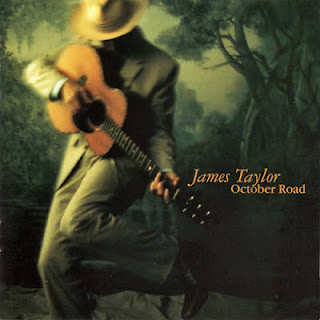
"October Road," by James Taylor


I bought this album in early September of 2002, shortly after its release and just one year after large-scale terrorism single-handedly imploded the United States with not only the magnitude of its evil destruction, but also by the debacle and needless disfigurement that would become a series of decade-long wars in the Middle East. And like everybody else in the country seemed to be in those days, I was in heavy introspection and reinvention mode. Thank God for James Taylor. I was ready for a diversion and for something hopeful, and after spending my 20’s in the wonderful town where I went to college I decided to take a job in a different location. And while a new work opportunity made me hopeful for what might lie ahead, the unfamiliar territory made me reflective and sentimental. This tender album served as my travel companion as I said “goodbye” to DeKalb, Illinois and made my new home in Lake Forest, Illinois.

Lyrically wistful and nostalgic, on October Road, Taylor sings about high school crushes, first kisses, football games, and the sights, sounds and smells of the months between the autumnal equinox to the winter solstice. In fact, songs on the album reference the entire second half of the calendar year: July through December. “On The 4th Of July,” “September Grass,” “October Road,” “Caroline I See You,” and even the seemingly out-of-place, but somehow-still-works cover of the holiday classic, “Have Yourself A Merry Little Christmas.” The album suggests the second half of the year as a time to wonder and rejoice, versus the hectic, hustle-and-bustle of the first two seasons. October Road reminds me of one of the best periods of my own life: the first year of being married to my partner. The album was the soundtrack to so many Chicago-land road trips together as Kristina and I navigated a new geographic region, weekend errands and groceries, carefree apartment living, and generally getting better acquainted. I treasure those days.

While there are numerous stand-out tracks on this album (i.e., the aforementioned, “September Grass” and the uber-mellow, grilled cheese and hot chocolate, one-two punch of “Caroline I See You” and “Baby Buffalo”), the songs on October Road are also of a piece, conjuring autumn and winter imagery: colored leaves on the ground, family and good friends, crisp, November air, and the smell of bonfires, hayrides, and pumpkin pie. Taylor’s lyrics on this album are road-worn and familiar, cozy and comforting. In fact, October Road reads like the third and fourth season travelogue of a man who has finally achieved a certain level of satisfaction and contentment with his life. And if my James Taylor history is correct, this serenity has been hard-won.

Most folks over a certain age know about James Taylor’s “soft rocking, hard living” early days, as one of the principle auteurs of the singer/songwriter genre (along with Joni Mitchell, Neil Young, Carly Simon, Bob Dylan, etc.), he created classic 1970’s hits, like “Fire and Rain,” “Handy Man,” “Your Smiling Face,” “Shower The People,” and his only number one, the 1971 Carole King-penned, “You’ve Got A Friend.” James Taylor has endured mental illness, rock stardom, drug abuse, and the fleeting trends of pop music, which tend to favor the tastes of 13-18 year-olds. Following suit, Taylor started to lose traction on the pop singles charts in the early 1980’s, as MTV, with it’s neon lights, hairspray, and synthesizers, effectively killed the radio star. The 80’s and 90’s passed quietly for Taylor, who released a sublime album every five years or so to his faithful followers, toured to support his new songs, and otherwise grew comfortable in his role as elder statesman of rock music. And we fans keep coming back for more, most recently on the sold out “Troubadours” tour with the equally legendary, Carole King. David Crosby has said that the debut album of a singer-songwriter represents 10 years of the musician’s work, but the second album, often written between gigs while promoting the first release, that’s where you can tell if an artist is any good. October Road is Taylor’s 15th album. Still good. Very good, indeed. 

Sunday, September 23, 2012

"Our Time In Eden," by the 10,000 Maniacs


My friend, Rachel, recently suggested I write about the 10,000 Maniacs breakthrough 1987 album, In My Tribe, which was, essentially, their introduction to a mass audience and my first listen to this remarkable band. But as I was listening to my Maniacs catalogue, I realized that I strongly preferred their final album with Natalie Merchant, Our Time In Eden, released in the fall of 1992, when I was starting my senior year of college. It brings back great memories: I didn’t have many financial resources in those days, so I don’t remember exactly how I purchased a copy of the album that September, but I did, and as it turns out, it was a worthwhile investment, as it turned out to be the best album they ever recorded.

The Maniacs followed-up In My Tribe, with the daunting, preachy, Blind Man’s Zoo, which had one solitary, mostly-cheerful song (and best cut on the album), “Trouble Me,” in which the tender video depicts Merchant as the key social director to a certain, lucky senior citizen. The rest of the LP was depressing and funereal. I remember buying the cassette of Blind Man’s Zoo the week I graduated high school in May of 1989. I would listen to it in my Walkman while I mowed the lawn at the farm that summer, and the maudlin music somehow comforted me as I dreaded the terrifying prospect that lie ahead: leaving my beautiful, Neponset countryside for university dorm life. Fitting, then, that the band decided to bookend my college career by releasing their follow-up to Blind Man’s Zoo the fall of my final year at Northern Illinois University.

Our Time In Eden, receiving a perfect, 5-star rating in Rolling Stone magazine at the time (a rating, which, somehow lost two stars over the past two decades in preceding RS publications), was exactly what I suspected from the band: serious-minded, catchy, and socially-conscious jingle-jangle-pop that was no-doubt informed by The Byrds, Big Star, and early-REM (relevant sidebar: I'm so glad REM retired; there's something to be said about bowing-out before it's too late: I'm lookin' at you, U2...). What’s not to love about that hybrid? Finally ejecting the tyrannical (and reportedly verbally abusive to the Maniacs) Peter Asher as producer, the band was able to loosen-up and have fun. Merchant’s lyrics are always aimed squarely at the heart and at the head, but on Eden, Merchant and the Maniacs kicked-up the fun, adding Motown horns and hard rock (no joke!) guitars to the folk-pop mix to which we fans had grown accustomed. The result? Sublime and timeless ear-candy.

The first “hit” on the album (#66) was the optimistic and hella-catchy, “These Are Days,” with a video featuring Merchant in a cute, white Gap sweater (only $12.99!) singing on top of New York skyscraper, with break-away shots of children running through the woods (was one of those kids wearing a Nixon mask? I’m not sure, but what about the boy with the “kiss me quiet” written on his forehead and the girl with the “squeeze me slow!” written on her stomach?) and college students playing footsy (I didn’t understand the point of the eye-patch on the dude, either, but I just went with it). Weird, you say? Not in the early 90’s, when flannel-wearing denizens of the era would have referred to it as simply, “granola.” I hate flannel shirts and black jeans to this day.

The second modest hit on the album (#67) was the Motown-influenced “Candy Everybody Wants,” about the evils of commercialism (“engineered opinions”) with the newly fashion-conscious Merchant blending genders in both a suit AND an evening gown, interspersed with the interchangeable “Simply Irresistible” girls and faux advertisements (“…lust and hate is the candy, and blood and love tastes so sweet”). Sigh... Socially conscious pop at it’s best. The irony of multi-million selling pop artists leveraging MTV to comment about the “travesty” of commercialism, to wit: “I don't want no lies, I don't watch TV, I don't waste my time reading magazines…” 

Nevertheless, Our Time In Eden is truly magnificent pop music, and if you’ve never heard it, I can’t recommend it enough. And thanks, Rachel, for reminding me of the 10,000 Maniacs. Great band. Great album.