Saturday, June 8, 2013

“Fandango,” by Pat Metheny, Alan Silvestri, and various artists

A first for this blog, and perhaps a first for any album review: I’m writing about an album that, technically, doesn’t exist. Also a first for this blog, Fandango is not a formal album by one particular artist, which is an underlying theme for this blog, but a compilation of many musicians. That said, it’s one of the best albums that never was from one of the most underrated films of the last few decades, so I’m including it, here. Fandango is a 1985 film, starring Kevin Costner in one of his first leading roles and directed by Kevin Reynolds, who would go on to work with Costner in Robin Hood: Prince of Thieves (1991) and the ill-fated, Waterworld (1995). But in 1981, Reynolds was a budding, student filmmaker, whose graduate student film, Proof, about the antics of his fraternity at Baylor University, caught the attention of one, Stephen Spielberg, who was impressed enough to offer financial backing for a feature-length film. Reynold’s graduate student short film became Fandango, one in a line of hundreds of archetypal, road trip/coming-of-age films. This one is set in the U.S. Vietnam era, 1971, and it follows the “farewell fandango” of “The Groovers,” a group of college friends, two of whom had just received notice that their draft deferral had expired, requiring them to report for military duty in the Vietnam, Laos, and Cambodia conflicts.

While the movie played all of two weeks in a limited number of theaters across the country, cable television and late-night syndication have given the film an extended shelf life, and it has garnered a dedicated cult following in the almost 30 years that have passed since its release. And deservedly so. It’s a cool movie. Regarding the rumored release of an official soundtrack, some “super fans” of the film report owning a uber-obscure cassette soundtrack of the film and claim the album had limited release in conjunction with the movie decades ago, but most seem to concur that the soundtrack for Fandango was never released as an actual album. And that’s a pity, since the music used in the film perfectly captures the sadness, angst, frustration, fear, and excitement of the five central characters, each facing vastly different, post-college fates.

The film includes classic rock tracks of the era by Cream, Elton John, Carole King, Classics IV, Blind Faith, and Steppenwolf, as well as perfectly fitting mood pieces by the legendary Los Lobos and the obscure, Milton Brown and the Brownies. These songs are interspersed with Alan Silvestri’s (Forrest Gump, Back To The Future, Cast Away, The Avengers, etc.) remarkably descriptive film score and three Pat Metheny contributions: the gentle piano ballad, “September Fifteenth,” an affectionate tribute to Bill Evans, who died during the song’s recording, “It’s For You,” which beautifully framed the wedding dance scene with Costner and Suzy Amis, which is the emotional centerpiece of the movie, and the heartbreaking, “Farmer’s Trust, (5:50 mark)” which sets the mood for the tender dénouement of the film. Pretty. Poignant. Perfect. Silvestri’s imaginative score is also, sadly, not widely available, save for a few Fandango songs being included on the end of the now-out-of-print soundtrack for the even more obscure, 1994 film, Blown Away.

That factoid and much of the other information about this exceptional, non-existent album was gleaned from an outstanding Fandango film fan site, which also suggests a soundtrack song list, but I’ve compiled my own, wonky iteration, here:

  1. Cream, “Badge”
  2. Elton John, “Saturday Night's Alright For Fighting”
  3. Los Lobos, “Ay Te Dejo En San Antonio”
  4. Carole King, “It's Too Late”
  5. Classics IV, “Spooky”
  6. Alan Silvestri, “Smooth Talk”
  7. Alan Silvestri, “The Other Side Of Madness”
  8. Alan Silvestri, “Acknowledgement”
  9. Steppenwolf, “Born To Be Wild”
  10. Milton Brown And The Brownies, “Taking Off”
  11. Pat Metheny And Lyle Mays, “September Fifteenth”
  12. Pat Metheny And Lyle Mays, “It's For You”
  13. Pat Metheny, “Farmer's Trust”
  14. Blind Faith, “Can't Find My Way Home”
I think what strikes me most about the songs Reynolds used for Fandango is the way, when taken together, they perfectly recreate the zeitgeist of that particular point in time for many White people in the United States: the end of the 1960’s and the beginning of the 1970’s. The music, when listened to as a piece, feels like that tumultuous era and conjures the thoughts and feelings connected to that moment of significant, political unrest and social upheaval, that moment of heartbreaking war and fear, that moment of great expectations and personal freedom. And Reynold’s classic movie does the same; it’s worth seeking out. Afterwards, you’ll need the above song listing (and a little internet ingenuity) to complete your own groovy soundtrack. 

“Here’s to us and to what we were.” 

“And what we’ll be...” 

Saturday, May 25, 2013

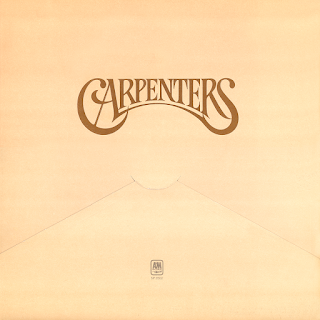
"Carpenters," by Carpenters


Carpenters’ sophomore effort, Close To You, launched the siblings into superstardom. The one-two punch of the #1 and #2 singles, “Close To You,” and “We’ve Only Just Begun,” respectively, catapulted the duo into the public eye, and that breakthrough album remains a fan, as well as a critical, favorite, landing high on Rolling Stone magazine’s list of “Top 500 Albums of All Time.” And deservedly so, but it was the album that followed, the eponymous “tan album,” which is lesser-known today, that stands as Carpenters’ highest-selling, non-compilation album, stateside. One might argue that the album’s stunning sales figures were singularly due to inertia from the Close To You phenomenon, and that may well be a factor, but I argue that the album, itself, contains some of the sibling’s best musical contributions and reflects the flavor of pop music in 1971. Relevant sidebar: tapping into the spirit of early 1970’s pop music was a knack for which brother Richard singularly possessed, with few missteps, for four solid years between 1970 and 1973. He was the Kanye West of that moment in pop music history.

And to be sure, Carpenters placed three of its singles into the top echelons of the charts that year, starting with the Oscar winning “For All We Know,” #3, from the film, Lovers And Other Strangers, followed by the classic Paul Williams/Roger Nichols track, “Rainy Days And Mondays,” #2, and the definitive version of Leon Russell’s, “Superstar,” #2, a song, which had previously failed to catch on, even after covers by “superstars,” Rita Coolidge and Bette Midler. Karen’s sensual reading, recorded in just one take, delivered the perfect rendering of heartbreak and unrequited love. The album reached #2 on the Billboard album chart, went on to win a Grammy, that year, for “Best Pop Vocal Performance – Duo or Group,” and perhaps most significantly, it introduced fans to the indelible, now instantly recognizable band logo.

Hits aside, the album delivered two quintessential Carpenter album tracks, a future commercial jingle, an obscure Henry Mancini composition, one song that would most certainly have been a top 5 hit, had it been released in 1971, one cringe-inducing moment, and one, extended track that may well be their most perfect, musical moment. Here's the rundown: 

Two quintessential Carpenters album tracks:
  1. “(A Place To) Hideaway” - A perfect song for the siblings’ old-fashioned style, this sentimental song was written by Randy Sparks, the founder of the New Christy Minstrels and author of the 1970’s wedding standard, “Today.”
  2. “One Love” – Richard lifted a line from this song of heartbreak in the liner notes for the first posthumous Carpenters album, Voice Of The Heart, “Few are the choices we are given; the sands of time pass quickly by…”


Future commercial jingle: “Saturday.”
When my partner and I moved to California a few years ago, we heard, on a television commercial, an even perkier (believe it or not) cover of this already bubbly ditty about the joys of Saturday. It’s one of the rare lead vocals by Richard and his second best, after “I Kept On Loving You,” from Close To You.

Obscure Henry Mancini composition: “Sometimes.”
As the story goes, in the late 1960’s, Henry Mancini’s daughter, Felice, wanted to give her parents a unique gift for the holidays, so instead of buying them a present, she wrote a poem about how much her family meant to her. Her famous composer father loved it so much, that he set the poem to music, and the siblings loved the resulting song so much, that they included it on their third album. It might be the gentlest song I’ve ever heard.

Had it been released in 1971, “Let Me Be The One” would have, most certainly, been a Top 5 hit. Having a smash hit with “We’ve Only Just Begun,” by the third album, the duo actively sought-out Roger Nichols/Paul Williams compositions for hits, and “Let Me Be The One” was strongly considered as a first-single off the sibling’s self-titled LP. Richard has noted, over time, that he regrets not releasing this one as a single, as he believes it would have easily been another top-5 hit in 1971. I’m inclined to agree.

Cringe-inducing moment: “Drucilla Penny.”
By this point in their career, Karen was the clear lead-singer for band, yet, Richard still, apparently, felt compelled to deliver the lead on a few songs on each album. Of all the songs Carpenter/Bettis might have written together for brother Richard to record, why this one? Its prissy, preachy, finger-wagging lyrics about groupies are just embarrassing (did Carpenters even have groupies?). This track, no doubt, did little to help the duo with rock critics that year.

Perfect musical moment: “Bacharach/David Medley.”
Before the siblings took over the world in the early 1970’s, they were fledgling musicians signed to A&M Records. Burt Bacharach was a fan of Carpenters’ version of “Ticket To Ride,” and he asked Herb Albert if the duo would put together a medley of Bacharach/Hal David songs for a 1969 fund-raiser. This is the medley Richard arranged, and legend has it that it was at this time that he was introduced to their break-through single, “Close To You.” Ernesto Lechner, from Rolling Stone magazine, indicated that the medley “…is arguably the group’s most impressive moment – light and breezy, slightly jazzy, the work of two young idealists who are still in love with life and its endless possibilities” (2004).

An apt description for both the medley and the entire album, and while not their most critically acclaimed release, that award goes to A Song For You, the “tan album” captures the duo at the most exciting moment in their lives and careers, both had just begun, and that spring, it seemed like anything was possible for Karen and Richard. And indeed, for the next few years in the early 1970’s, everything they touched seemed to turn to gold. 

Saturday, December 22, 2012

"For The Roses," by Joni Mitchell


Not that I needed any encouragement, but my 2012 summer jam, John Mayer’s Born and Raised, has plunged me even more deeply into an ongoing preoccupation with all things “early 1970’s rock-and-roll” and all things Laurel Canyon. And one can’t discuss the Laurel Canyon rock-and-roll period without significant homage to the “Queen of California,” herself, Joni Mitchell. In fact, Mitchell’s early legacy is synonymous with that legendary zip code. Joni Mitchell has evolved through myriad musical phases in her remarkable career, taking fans along for the staggering ride: starting with her hippie-chick, Joan Baez/Judy Collins-influenced singer-songwriter phase during the late 1960’s (singer-songwriter: a job that Mitchell, arguably, invented) into the early 1970’s pop-jazz chanteuse, into the later part of that decade’s jazz experimentalist, the 1980’s prog-pop innovator (the Thomas Dolby produced album, Dog Eat Dog was sorely under-heard and under-appreciated - oh, and the inventive video was produced by Jim Blashfield, who created Tears For Fears' "Sowing The Seeds Of Love" clip), and into the 1990’s adult contemporary smooth-jazz (muzac?) and current elder stateswoman of rock and roll. Mitchell is no less revered in her current incarnation as the smoky-voiced, pop interpreter of recent years, and there’s even talk in 2013 of a David Geffen-induced career “comeback.” As if she ever left.

And everybody talks about either Blue or Court and Spark when they discuss Mitchell’s best work, and deservedly so, but I posit that the album Mitchell produced between those two classics, For The Roses, is a forgotten masterpiece. Blue was exquisite, to be sure, with it’s spare arrangements, cringe-inducing, horrifyingly-personal lyrics, and stupefying, heartbreaking themes (indeed, it may be the quintessential break-up album) and Court And Spark, which covered similar themes but did so while immersing itself in smooth jazz (before it became it’s own, Velveeta-flavored genre) remains my favorite Mitchell album, but For The Roses serves as the perfect transition album between Mitchell’s folky musings and her superb, genre-expanding jazz phase. While it contained one of Mitchell’s precious few top 40 hits (“You Turn Me On, I’m A Radio,” #25 in 1973), in 2007, For The Roses was one of 50 recordings chosen by the Library of Congress to be added to the National Recording Registry (it is Mitchell's first and, so far, only album to make that list).

The themes of the songs on For The Roses are classic, early-Joni Mitchell: cutting open her love-life arteries for all to see. While Mitchell leveraged the same approach for Blue, the songs on For The Roses were less universal and more specific to Mitchell’s own narrative. Interestingly, I recently had opportunity to attend a recording of a Taylor Swift concert for Vh1: Storytellers, promoting her latest album, Red (Red, huh? Kinda like another album title, Blue, no? Nah, it couldn’t be that calculating...). Not being familiar with Swift’s music before the show, I found myself struggling with her shtick, and then I found myself struggling with my own skepticism. Why was I so disbelieving towards Swift’s “art,” when, essentially, she holds many parallels with Mitchell, who herself started as a young, pretty, long haired blond, playing guitar and dulcimer (Swift’s other instrument is the banjo), whose first few albums were, essentially, full of songs about breaking-up with boyfriends? As I watched the peppy, sparkly, staged spectacle, it dawned on me that, besides the silly lyrics (to wit, “Cause I love the gap between your teeth; And I love the riddles that you speak; And any snide remarks from my father about your tattoos will be ignored; Cause my heart is yours” – sorry ‘bout that, gentle readers, but now you understand...), it was the crass commercialism surrounding the spectacle: the concert was sponsored by a pizza company giving out boxes painted with Swift’s face as well as Swift-inspired greeting cards and Swift-inspired “make-overs” and the giggly, “I’ve-sold-millions-of-albums-and-am-still-insecure-oh-my!” palms to her cheeks banter between her songs. Miss Swift is a product line; Joni Mitchell is a musician.

But I digress; back to For The Roses. So I hate the album cover, which features Mitchell, squatting in the woods on her Canadian property, wearing moccasin boots and a green velvet “hippie” shirt, which would fit perfectly at modern-day, “Renaissance Fairs.” The album’s inside cover featured Mitchell in the nude, staring into the ocean (Which, I guess, stands to reason, as her lyrics left nothing to the imagination; so why not just put everything out there?). If you’re not already Joni’s, this album may be a great place to begin. Stylistically, For The Roses is leaps and bounds beyond Blue, blending her folk-rock musings to her jazz influences and beautifully so.

The lead-off song, “Banquet,” predates Obama’s notion of “spreading the wealth” by almost 40 years, pointing out the inequality of Capitalism, "Cold Blue Steel and Sweet Fire" describes harrowing heroin addiction, growing in prevalence in the L.A. scene in the early 1970’s, which is part of the reason Mitchell took refuge in her native Canada as she wrote this magnificent follow-up to Blue. "Barangrill," about the charms of a Canadian roadside truck stop, is my favorite track, because it takes me back to the sound of the early 70’s, singer-songwriter, “Schoolhouse Rock” vibe. In fact, if my memory serves me correctly, everything sounded like a “Schoolhouse Rock” jingle, back then. Blossom Dearie is greatly missed... The rest of the album continues the early 1970’s groove, vacillating from love song to social observation and exquisitely so, hinting to listeners what lie ahead in her next few releases.

Recently, Joni Mitchell has expressed frustration that all her fans ever want to hear from her is more songs about her love life, and I’ll grant her that complaint, but in our defense, I posit that her best writing is about that very topic. In fact, I find her best work connected to times of personal turmoil, and some of her most tepid work was produced when she was happily in love...go figure. So, yeah, I suspect I speak for most Mitchell fans when I say that we’re still holding out for Blue, Too.” That said, Mitchell’s most recent release, 2007’s Shine, might just be THAT record. Critics were all over the map, but I thought the album was sublime, proving that Mitchell, after all these years, has still got it. Please record again, Joni Mitchell; we’re still turned on.

Thursday, December 20, 2012

"The Seeds Of Love," by Tears For Fears


A few years ago I read an interview with a “hot” young musician, who subsequently faded away (forgive my feeble memory; I don’t remember his name; it’s on the tip of my tongue…), who was backhandedly complimenting Tears for Fears during their commercial heyday, citing their classic pop hits, like “Everybody Wants To Rule The World,” “Shout,” and “Sowing The Seeds Of Love,” as “wonderful, but dated, forever stuck in 1980’s synthesizers.” I have to disagree. I liken describing Tears for Fears’ music as “stuck in the 1980’s,” to saying David Bowie’s music is stuck in the 1970’s. Is it a product of its cultural and musical timeframe? Certainly, but isn’t that precisely from where it derives its artistic power and musical strength? Isn’t that the job of pop music, to reflect the mores and zeitgeist of the moment in 3-minute verse-chorus-verse format?

But hype is fascinating like that. Don’t believe me? Watch your facebook newsfeed evolve after a national event; it serpentines, with facebook friends jumping on the bandwagon of the thought-o-the-moment with cattle stampede-like trajectories of opinion. And so it goes with the music industry that hypes “the next big thing,” only to turn 180 degrees months, weeks, days later when it appears the trend is going in a different direction. Popular music is riddled with artists who should have been the “second coming,” only to fall short when trends shift. To wit, in the 1970’s, insiders speculated that The Knack was, secretly, the re-formed Beatles (sigh…if only), in the 1980’s, Terence Trent D’Arby was supposed to be the second coming of James Brown (sadly, not), and in the 1990’s, Sophie B. Hawkins was supposed to alter the direction of popular music (that said, I still enjoy her eccentric, sadly underappreciated music). And after their 15 minutes of fame were spent, these artists faded into their respective obscurities.

Such was the case with Tears for Fears much touted third release, The Seeds Of Love. Buoyed by the accumulated success of their previous two albums, the critically acclaimed, but slow-burning (in the U.S.) debut, The Hurting, and the world-wide, multi-platinum smash of Songs From The Big Chair, Roland Orzabal and Curt Smith were poised for musical world domination with their highly and long-anticipated follow-up, The Seeds Of Love. Indeed, arriving four years after its predecessor, The Seeds Of Love was to be the next big thing. How could it not be that? The first single, “Sowing The Seeds Of Love,” with it’s Beatles-influenced backdrop and inventive, accompanying video, rocketed to #2 on the Billboard chart and worked the awaiting, record-buying public into a frenzied froth (as a good lead-off single should). So much so, that in its November 1989 album review, the trend-conscious Rolling Stone magazine gave the album an almost perfect review: four out of five stars, reviewer Michael Azerrad stated, “…it's exciting that such thought-provoking music will undoubtedly be so widely heard. If with the title track Tears for Fears beg comparison to the Beatles, it's in the unspoken assertion that popular music can also be outstanding music. That's something this remarkable record proves over and over again.” 

Well said, Mr. Azerrad, well said. But just one year later in its year-end issue, the same publication trashed the album, calling the songs meandering and “overlong.” So which is it, Rolling Stone? What changed about the album in 10 months? Was it good or not? Apparently not, or maybe something else was afoot. After all, the subsequent singles from the album faired far less than the leadoff single (hard to imagine a feminist anthem competing strongly against the featherweight pop of Wilson Phillips, Michael Bolton, and Milli Vanilli). MTV, pop radio, and the record-buying public couldn’t be wrong about this one…right?

Whichever way you look at it, I’m inclined to agree with Azerrad’s original opine: The Seeds Of Love is a remarkable piece of work, likely the duo’s best effort, and worthy of another listen (or two or three…). Featuring only eight songs, side one became the “singles” side, featuring three of the most well-known singles from the album, the grandiose, everything-but-the-kitchen-sink #2 smash, “Sowing The Seeds Of Love,” the sensitive-man-as-feminist duet with (the stunning) Oletta Adams, “Woman In Chains,” and the playful, sunshine pop confection, “Advice For The Young At Heart,” with the borrowed John Lennon line, “Love is a promise, love is a souvenir; once given, never forgotten, never let it disappear…” The final song on the album, “Famous Last Words,” while one of my favorite tracks, was released as the album’s last single but disappeared without a trace as the album, by that time, had been widely forgotten by all parties concerned.

While references to The Beatles are undeniable (even down to the Sgt Pepper’s-like collage of an album cover), I liken The Seeds Of Love less to any, one Beatles album than I would compare it to Pink Floyd’s perennial classic, Dark Side of The Moon, with its swirling jazz riffs, melancholy atmospherics, sweeping soundscapes, and soulful, tortured vocals by Oletta Adams, who went on to a highly successful career as a soul singer after being launched by this album. Indeed, the tracks on Seeds Of Love, like the tracks on Dark Side Of The Moon, are longer than the standard pop song, clocking-in at an average of over 6 minutes, but Orzabal seemed to be going more for Alan Parsons style epics than catchy 3 minute pop petit fours. Viewing his entire catalogue, I’ve come to believe that Roland Orzabal can’t not write a song without a tangible melody, and Seeds Of Love is no exception. That said, the album is scarce on pop hooks, per se, but the album seems crafted to build a significantly more satisfying musical experience over time, with repeated listens, much like Dark Side Of The Moon’s epic journey, except instead of a musical case study in madness, Seeds Of Love examines a road map of the human heart. We seem to still need that...