Hey, music fans: can’t get enough of “You Must Hear This Album?” Then be sure to click the image on your left and “like” YMHTA on facebook.
Rock on, Star Child...
Friday, August 9, 2013
Friday, August 2, 2013
"Seasons Of My Soul," by Rumer
Rumer is, by far, the best singer-songwriter making music
today, but shamefully few seem to know it. But that’s all about to change, as Sir Elton John recently noted, “the world needs Rumer’s songs.” I couldn’t agree more. Rumer
is a British singer-songwriter, and 2010’s Seasons
Of My Soul is her stunning debut. Much has been noted about Rumer’s
affinity for the oldies, and the observation resonates, as Rumer’s work is so much
informed by the sun-faded, easy-listening music of the late 1960’s and early 1970’s,
including Burt Bacharach, Judee Sill, The Beach Boys, Dusty Springfield, John
Sebastian, Hall & Oats, and Bread, to name a few. In fact, listening to
Rumer’s debut is akin to listening to John Mayer’s 2012 album, Born And Raised (as well as his forthcoming,
Paradise Valley, which reportedly
follows the same early 1970’s rock muse): the music on these modern albums pays homage to the
past, illustrating that there’s still so much more to be gleaned, so much more
terrain to explore inside that golden era of popular music.
The album took about a year to record, which gave birth to
the album title, as Rumer noticed that the songs she’d completed earlier in the
recording process were “coming back” to her, emotionally, like with the seasons.
Opening with the album’s first single, “Slow,” (#16, UK) is the perfect
introduction to the album, as the song, with its smooth, slow-jam shuffle and
silky, milk chocolate vocal is wholly representative of the record and of this
gifted artist. The album’s second single, the consoling, “Aretha,” pays tribute
to the Queen of Soul, from the ears and heart of a young girl at school, trying
in vain to fit-in and finding solace from the words and music of the legendary
artist: and who, at some point or another, hasn’t been completely buoyed and
transported by Aretha Franklin’s songs?
There are two non-ballads on the album, the carbonated,
Sesame Street-styled, “Am I Forgiven?” which skips along joyfully, reminiscent
of the Archies or 1910 Fruitgum Co., which is a huge compliment, by the way. The other
non-ballad is an equally engaging piece of ear candy, the delightful, “Saving Grace,” another slice of “bubblegum” pop confection, where Rumer exultantly
sings, “Because you’re the one who
makes me see; you are my saving grace; you make me want to become; become
better…” Roll calling her musical heroes, the album also contains a dreamy
cover of David Gates’ 1977 top-20 hit, the theme song from Neil Simon’s,
“Goodbye Girl,” and the deluxe version of the album contains three additional
cover tunes: Paul Simon’s lovely, “Long, Long Day,” The Beach Boy’s 1964
classic, “Warmth Of The Sun,” and fittingly, a cover of Bacharach & David’s
1965 classic, “Alfie.” Rumer went on to leverage this approach with significant
panache on her sophomore effort, Boys Don’t Cry, a covers album
featuring 1970’s songs, both popular and obscure, by acclaimed songwriters.
The title ironically labels an album of emo (before it was even a thing) songs,
all written by men.
The album ends with a tender trio of perfectly constructed ballads,
starting with the pleadingly gentle waltz, “Take Me As I Am,” which leads into the
album’s very best tune, the contemplative, serene “Thankful,” where the theme
of the album is extracted, following the trajectory of love through the lens of
the four seasons: from spring to summer, where she fondly recalls one
particular afternoon, “…doing the dishes at the window and the radio’s playing
‘Superstar...’” to autumn and winter, sighing a tearful goodbye to a loved one,
“In the Forest of Angels, that’s where we laid you down, and I can hear you
whisper when the first frost falls on the ground: ‘you’re alive, just be
thankful for this time.’” The ethereal, “On My Way Home,” closes this
exceptional album with the prayerful couplet, which surrenders, “Oh, my God,
oh, my God; I am yours…” Magnificent. And while all but two of the songs barely
rise above a whisper, Seasons Of My Soul
powerfully unpacks the beauty, joy, sadness, and compassion contained in the
human heart. Yep, the world needs Rumer’s songs.
Sunday, July 7, 2013
"Baby I’m-A Want You," by Bread
In some ways, an album like Baby I’m-A Want You by a band like Bread, is the epitome of what
this blog is all about: a long-forgotten, well-crafted, pop album by an
underappreciated band that deserves a dusting off and another spin on the
turntable (or another “click” on the iPod). And Bread was an exceptional band
that just never received its due for being one of the most consistently
listenable acts of the early 1970’s (although there was a terrific, non-ironic 2005 tribute album). Baby
I’m-A Want You stands as one of their very best albums (that said, there’s
something to appreciate about all of
their original albums released in the precious, few years they were together between
1969 and 1977).
But first, a few U.S. career highlights from this
significantly misunderstood band:
· In their heyday, Bread racked-up 12 top-40 hit
songs between 1970-1977
· 7 of those were top-10 hits
· Their solitary #1 hit, “Make It With You,” is a
classic slice of early-1970’s pop balladry and has been covered by many over
the years, including the legendary Dusty Springfield, whose tragically obscure version
stands as the definitive version and
is well-worth seeking out
But besides these points on a graph, Bread was simply an
exceptional band of songwriters and musicians, signaling in 1969, “…the birth
of Californian soft rock, as David Gates and compatriots blended the folk-rock
of The Byrds and Buffalo Springfield with a distinctly British melodicism and a
streak of sentimentality borrowed from McCartney” (All Music, 2013). Lofty and accurate comparisons, no? In fact,
beyond their work with Bread, individual band members had notable achievements
through the 1970’s and 1980’s and into the 1990’s, including band members Rob
Royer’s and James Griffin’s Oscar-winning song, “For All We Know,” from the
film Lovers And Other Strangers in
1970, as well as David Gates’ #15 solo hit from the Neil Simon film, Goodbye Girl in 1977 and his #30 hit,
“Took The Last Train,” in 1978. Additionally, Griffin, Royer, and Mike Botts
had continued success in the 1980’s and 90’s as songwriters and performers in
the Country Music genre. Clearly, band members were overflowing with talent and
ideas.
And peaking at #3 in 1972, Baby I’m-A Want You, the band’s fourth album, was its biggest hit, featuring
radio classics such as, “Mother Freedom,” #37 in July of 1971, “Baby I’m-A Want You,” #3 in October of 1971, “Everything I Own,” #5 in January of 1972, and
“Diary,” #15 in April of 1972. And beyond the radio hits, Baby I’m-A Want You included fan favorites, like the rocking, “Down On My Knees,” the surreal, imaginative “Dream Lady,” which I’ve always suspected inspired
Gary Wright’s 1976 hit, “Dream Weaver,” both musically and lyrically, the
equally dreamlike, “Games Of Magic,” the wistful, “Just Like Yesterday,” and
the finger-wagging, lecture song, “Daughter.” Along with “Mother
Freedom,” the album’s other civically minded tune, “This Isn’t What The
Governmeant,” (See what they’re doing there?) provides the typical
left-of-center, partisan political commentary rock bands were issuing in those
days. And Baby I’m-A Want You is an
exceptional album for its time; a sun-faded Polaroid of a remarkable and melodic
era in popular music.
But by 1973, internal tensions pulled the band apart, and depending
on the account to which you most prescribe, the rift was either caused by
ongoing tension between principle songwriters, David Gates and James Griffin,
over which songs would be selected as singles, with Gates’ mellow songs having
the best commercial track record over Griffin’s more rock-driven songs, or it
was caused by the record label, Elektra,
that wanted to keep the band pigeonholed as hit making, “softy” balladeers,
when the band wanted to explore other sounds and highlight their edgier,
guitar-driven work. Either way, the tension makes sense; if you look beyond
their best known, Gates ballad singles, the band rocked as hard or harder than
many of their contemporaries on the radio at that time (to wit, the
trend-conscious, “Truckin’,” which captured the early-mid 1970’s romanticized fascination with the trucking profession, “Let Your Love Go,” and
“London Bridge,” to name just a few). But whatever the actual formula for its
demise, I guess longevity wasn’t meant to be for the band, and the good lads
went their separate ways in 1978.
In the late 1990’s, Gates, Griffin, Botts and Knechtel came back together for the inevitable nostalgia reunion tour, but to the best of my
knowledge, they recorded no new material at that time. Sad, that, as just a few
years later, Mike Botts and James Griffin were dead from cancer. Larry Knechtel
died of a heart attack in 2009. And that, music fans, was the end of Bread. Most
folks who appreciate the hits have already sated their appetites with the
double-CD, Bread Retrospective,
released in the 1990’s, but there’s much buried treasure and even more insight
to be gained from picking up the original albums that carried these 1970’s pop
gems, which helped usher-in not only “soft rock,” but also the
singer-songwriter era of the early 1970’s.
Sunday, June 16, 2013
“Carole King: Music,” by Carole King
In January of 1971, Carole King and a group of her friends
recorded an album at A&M Records that defined an era. Tapestry was a classic-filled monster, holding the #1 position on Billboard’s
album charts for four months that summer and launching King as a superstar. Up to that point, Carole King had been most known as a writer of pop hits (e.g., “Will You Love Me Tomorrow?” “(You Make Me Feel Like A) Natural Woman,” “Up On A Roof,” “The Loco-motion,” etc.), but Tapestry signaled the musician as one of the most reliable singles artists of the coming decade.
Indeed, while her albums made less and less impact as the decade wore on (exceptions: Really Rosie, in 1975, and Pearls: Songs of Goffin and King, in 1980), King
delivered some of the best, 1970’s radio-ready ear-candy, including such staples as,
“Been To Canaan,” “Nightingale,” “Jazzman,” “Only Love Is Real,” and “Hard Rock Café,” helping us to navigate that tumultuous, stone washed decade.
Later that same year, King and friends returned to the studio, amidst the avalanche of promotion and performances that followed the massive success of Tapestry, and they crafted the magnificent
and sadly underappreciated, Carole King: Music. Now, here’s the thing: rock writers always make one of three observations
about any follow-up to a blockbuster album: 1.) “Ugh, it’s a mechanical,
cash-in rewrite of their last album,” 2.)
“Ugh, it’s an artist trying too hard to be fresh; they should have stuck with
what they do best, you know, like on their last album,” 3.) “Sigh, the new album’s okay, but doesn’t quite possess the
“magic” of their earlier work, you know, like on the last album.” Responding to Music,
critics o’ the moment took all three positions: Robert Christgau called Music “mechanical,” and Rolling Stone suggested King had strayed
too far from the Tapestry formula and
that Music “…doesn't have its
predecessor's sure, unified sense of style.” Sigh. “...Sometimes you win, sometimes
you lose…”
I’d argue, however, that Music
stands not only as one of King’s very best albums, ever, but constitutes an album of
songs that any artist of that time (or of this time!) would have killed
for. In fact, two of the songs were
recorded and made hits by other artists, including Karen and Richard Carpenter, who took
“It’s Going To Take Some Time” to #12 in the spring of 1972. Ironically, that Music arrived in the wake of the Tapestry behemoth both ensured its
success (it reached #1 just a few, short weeks after its December, 1971 release)
and sealed its fate as the “oh, that was the so-so next album...” In fact, all of
King’s subsequent (and consistently solid) work, post-Tapestry, faced the same, unfair comparison. No matter, though, as
King has certainly received her due, with numerous Grammy awards, gold/platinum
albums, hit songs, induction into the Rock-and-Roll Hall of Fame, and this May,
King was the first woman recipient of the Library of Congress “Gershwin Prize”
for popular song. Well done, Library of Congress, well done.
Music opens with
the engrossing, “Brother, Brother,” written just months on the heels of Marvin
Gaye’s classic single, “What’s Going On,” also with the phrase, “Brother,
brother…” Was it an echo of Gaye’s lyric, as Rolling Stone suggested? A
response to Gaye’s anthemic statement? Or was it more personal for King, whose
own brother lived with disability? It works beautifully, either way,
and remains a fan favorite, as well as one of many shoulda-been-a-hit-single songs off the album. Other songs that
could have been big hits in 1972 include: “Surely,” which is an voluptuary
slice of blue-eyed soul that could have been a big hit for King or for any
number of R&B artists from the era (e.g., Al Green, Aretha Franklin, Dusty Springfield, Diana Ross, etc.), the sweet, James Taylor harmonied, “Song Of Long Ago,” and the
vibrant, catchy-as-hell, “Brighter.”
All would have faired more than well amongst the trifle hit
songs of 1972: “Alone Again (Natrually)” (Ugh. Because you deserve to be), “Candy Man” (Um, creepy much?), “Brand New Key” (Maybe, brand new...NO!), and “Baby, Baby Don’t Get Hooked On Me” (Don’t worry, I won’t. Seriously...). And
speaking of singles, King’s label at the time, Ode, oddly released only one single
from Music, the wonderfully sunny,
“Sweet Seasons,” which reached #9 in the spring of 1972. Interesting side note:
the B-side of the “Sweet Seasons” single is a lost gem, “Pocket Money,” from
the long-forgotten 1972 film of the same name, starring Paul Newman and Lee
Marvin: a great, unheard song, but widely available today on various CD and digital
formats and one that I include as a “bonus” track for this superb album, as it was likely recorded during the Music sessions and nicely fits the overall tone of the album.
Other key album cuts include King’s version of her own song,
“Some Kind Of Wonderful,” which is a slowed down iteration of The Drifters’ magnificent
hit song from 1961. What I love about King’s version is how intimate the lyrics
become with her tender reading. “Carry Your Load” contains a solicitous lyric about
the support and kindness of an old friend. I think about this song most when I
think about Kristina and Simon. And of course, there’s the title track,
“Music,” that’s lyrics testify to the uplifting power of music, and more
specifically, the sheer pleasure of writing music for the masses – what a great
privilege that must be: “…Ah, summer is over; But the music keeps playing…pictures
are forming inside my brain; Soon with the colors they'll rain together and
grow…but the music keeps playing.” An apt description of the writing process.
And my favorite song is the album’s finale, “Back To California,” which Rolling Stone
magazine, in 1971, called a “throwaway” track. It’s my favorite song on the
album, albeit for personal reasons. In the last 24 months, it’s become
Kristina’s and my theme song: a love song to our adopted home state. After flying back last year from a trip did we realize how thrilled we were to be coming
“home” to California. King’s lyric resonated: “So won't you carry me back to California; I’ve been on the road too long; take me to the
West Coast, daddy, and let me be where I belong…” I return to Carole King: Music, just as often.
Saturday, June 8, 2013
“Fandango,” by Pat Metheny, Alan Silvestri, and various artists
A first for this blog, and perhaps a first for any album
review: I’m writing about an album that, technically, doesn’t exist. Also a
first for this blog, Fandango is not
a formal album by one particular artist, which is an underlying theme for this
blog, but a compilation of many musicians. That said, it’s one of the best
albums that never was from one of the most underrated films of the last few
decades, so I’m including it, here. Fandango
is a 1985 film, starring Kevin Costner in one of his first leading roles and
directed by Kevin Reynolds, who would go on to work with Costner in Robin Hood: Prince of Thieves (1991) and
the ill-fated, Waterworld (1995). But
in 1981, Reynolds was a budding, student filmmaker, whose graduate student film,
Proof, about the antics of his fraternity
at Baylor University, caught the attention of one, Stephen Spielberg, who was
impressed enough to offer financial backing for a feature-length film.
Reynold’s graduate student short film became Fandango, one in a line of hundreds of archetypal, road trip/coming-of-age
films. This one is set in the U.S. Vietnam era, 1971, and it follows the “farewell
fandango” of “The Groovers,” a group of college friends, two of whom had just
received notice that their draft deferral had expired, requiring them to report
for military duty in the Vietnam, Laos, and Cambodia conflicts.
While the movie played all of two weeks in a limited number
of theaters across the country, cable television and late-night syndication
have given the film an extended shelf life, and it has garnered a dedicated cult
following in the almost 30 years that have passed since its release. And
deservedly so. It’s a cool movie. Regarding the rumored release of an official soundtrack,
some “super fans” of the film report owning a uber-obscure cassette soundtrack of
the film and claim the album had limited release in conjunction with the movie
decades ago, but most seem to concur that the soundtrack for Fandango was never released as an actual
album. And that’s a pity, since the music used in the film perfectly captures
the sadness, angst, frustration, fear, and excitement of the five central
characters, each facing vastly different, post-college fates.
The film includes classic rock tracks of the era by Cream,
Elton John, Carole King, Classics IV, Blind Faith, and Steppenwolf, as well as perfectly
fitting mood pieces by the legendary Los Lobos and the obscure, Milton Brown
and the Brownies. These songs are interspersed with Alan Silvestri’s (Forrest Gump, Back To The Future, Cast Away,
The Avengers, etc.) remarkably
descriptive film score and three Pat Metheny contributions: the gentle piano
ballad, “September Fifteenth,” an affectionate tribute to Bill Evans, who died
during the song’s recording, “It’s For You,” which beautifully framed the
wedding dance scene with Costner and Suzy Amis, which is the emotional
centerpiece of the movie, and the heartbreaking, “Farmer’s Trust, (5:50 mark)” which sets
the mood for the tender dénouement of the
film. Pretty. Poignant. Perfect. Silvestri’s imaginative score is also, sadly,
not widely available, save for a few Fandango songs being included on the end
of the now-out-of-print soundtrack for the even more obscure, 1994 film, Blown Away.
That factoid and much of the other information about this
exceptional, non-existent album was gleaned from an outstanding Fandango film fan site, which also
suggests a soundtrack song list, but I’ve compiled my own, wonky iteration,
here:
- Cream, “Badge”
- Elton John, “Saturday Night's
Alright For Fighting”
- Los Lobos, “Ay Te Dejo En
San Antonio”
- Carole King, “It's Too
Late”
- Classics IV, “Spooky”
- Alan Silvestri, “Smooth
Talk”
- Alan Silvestri, “The Other
Side Of Madness”
- Alan Silvestri, “Acknowledgement”
- Steppenwolf, “Born To Be
Wild”
- Milton Brown And The
Brownies, “Taking Off”
- Pat Metheny And Lyle Mays,
“September Fifteenth”
- Pat Metheny And Lyle Mays,
“It's For You”
- Pat Metheny, “Farmer's
Trust”
- Blind Faith, “Can't Find
My Way Home”
I think what strikes me most about the songs Reynolds used
for Fandango is the way, when taken
together, they perfectly recreate the zeitgeist of that particular point in
time for many White people in the United States: the end of the 1960’s and the
beginning of the 1970’s. The music, when listened to as a piece, feels like that tumultuous era and conjures
the thoughts and feelings connected to that moment of significant, political
unrest and social upheaval, that moment of heartbreaking war and fear, that moment
of great expectations and personal freedom. And Reynold’s classic movie does
the same; it’s worth seeking out. Afterwards, you’ll need the above song
listing (and a little internet ingenuity)
to complete your own groovy soundtrack.
“Here’s to us and to what we were.”
“And what we’ll be...”
“Here’s to us and to what we were.”
“And what we’ll be...”
Labels:
and Steppenwolf,
Blind Faith,
Carole King,
Classics IV,
Cream,
Elton John,
Kevin Costner,
Los Lobos
Saturday, May 25, 2013
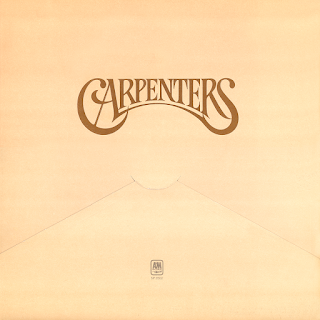
"Carpenters," by Carpenters
Carpenters’ sophomore effort, Close To You, launched the siblings into superstardom. The one-two
punch of the #1 and #2 singles, “Close To You,” and “We’ve Only Just Begun,”
respectively, catapulted the duo into the public eye, and that breakthrough
album remains a fan, as well as a critical, favorite, landing high on Rolling Stone magazine’s list of “Top
500 Albums of All Time.” And deservedly so, but it was the album that followed,
the eponymous “tan album,” which is lesser-known today, that stands as
Carpenters’ highest-selling, non-compilation album, stateside. One might argue that the album’s stunning
sales figures were singularly due to inertia from the Close To You phenomenon, and that may well be a factor, but I argue
that the album, itself, contains some of the sibling’s best musical contributions
and reflects the flavor of pop music in 1971. Relevant sidebar: tapping into the spirit of early 1970’s pop music was a knack for which brother Richard singularly possessed, with few missteps, for four solid years between 1970 and 1973. He was the Kanye West of that moment in pop music history.
And to be sure, Carpenters
placed three of its singles into the top echelons of the charts that year,
starting with the Oscar winning “For All We Know,” #3, from the film, Lovers And Other Strangers, followed by the
classic Paul Williams/Roger Nichols track, “Rainy Days And Mondays,” #2, and the definitive
version of Leon Russell’s, “Superstar,” #2, a song, which had previously failed to
catch on, even after covers by “superstars,” Rita Coolidge and Bette Midler.
Karen’s sensual reading, recorded in just one take, delivered the perfect
rendering of heartbreak and unrequited love. The album reached #2 on the
Billboard album chart, went on to win a Grammy, that year, for “Best Pop Vocal
Performance – Duo or Group,” and perhaps most significantly, it introduced fans
to the indelible, now instantly recognizable band logo.
Hits aside, the album delivered two quintessential Carpenter
album tracks, a future commercial jingle, an obscure Henry Mancini composition,
one song that would most certainly have been a top 5 hit, had it been released
in 1971, one cringe-inducing moment, and one, extended track that may well be
their most perfect, musical moment. Here's the rundown:
Two quintessential
Carpenters album tracks:
- “(A Place To) Hideaway” - A perfect song for the siblings’ old-fashioned style, this sentimental song was written by Randy Sparks, the founder of the New Christy Minstrels and author of the 1970’s wedding standard, “Today.”
- “One Love” – Richard lifted a line from this song of heartbreak in the liner notes for the first posthumous Carpenters album, Voice Of The Heart, “Few are the choices we are given; the sands of time pass quickly by…”
Future commercial
jingle: “Saturday.”
When my partner and I moved to California a few years ago,
we heard, on a television commercial, an even perkier (believe it or not) cover of this already bubbly ditty
about the joys of Saturday. It’s one of the rare lead vocals by Richard and his
second best, after “I Kept On Loving You,” from Close To You.
As the story goes, in the late 1960’s, Henry Mancini’s
daughter, Felice, wanted to give her parents a unique gift for the holidays, so
instead of buying them a present, she wrote a poem about how much her family
meant to her. Her famous composer father loved it so much, that he set the poem
to music, and the siblings loved the resulting song so much, that they included
it on their third album. It might be the gentlest song I’ve ever heard.
Had it been released
in 1971, “Let Me Be The One” would have, most certainly, been a Top 5 hit.
Having a smash hit with “We’ve Only Just Begun,” by the third album, the duo
actively sought-out Roger Nichols/Paul Williams compositions for hits, and “Let Me Be The One” was strongly considered as a first-single off the sibling’s self-titled
LP. Richard has noted, over time, that he regrets not releasing this one as a
single, as he believes it would have easily been another top-5 hit in 1971. I’m
inclined to agree.
Cringe-inducing
moment: “Drucilla Penny.”
By this point in their career, Karen was the clear
lead-singer for band, yet, Richard still, apparently, felt compelled to deliver
the lead on a few songs on each album. Of all the songs Carpenter/Bettis might
have written together for brother Richard to record, why this one? Its
prissy, preachy, finger-wagging lyrics about groupies are just embarrassing (did
Carpenters even have groupies?). This track, no doubt, did little to help the duo with rock critics that year.
Before the siblings took over the world in the early 1970’s,
they were fledgling musicians signed to A&M Records. Burt Bacharach was a
fan of Carpenters’ version of “Ticket To Ride,” and he asked Herb Albert if the
duo would put together a medley of Bacharach/Hal David songs for a 1969
fund-raiser. This is the medley Richard arranged, and legend has it that it was
at this time that he was introduced to their break-through single, “Close To
You.” Ernesto Lechner, from Rolling Stone
magazine, indicated that the medley “…is arguably the group’s most impressive
moment – light and breezy, slightly jazzy, the work of two young idealists who
are still in love with life and its endless possibilities” (2004).
An apt description for both the medley and the entire album,
and while not their most critically acclaimed release, that award goes to A Song For You, the “tan album” captures
the duo at the most exciting moment in their lives and careers, both had just
begun, and that spring, it seemed like anything was possible for Karen and
Richard. And indeed, for the next few years in the early 1970’s, everything
they touched seemed to turn to gold.
Subscribe to:
Posts (Atom)